Substack Alternatives: The Math Past 49 Paying Readers
Substack’s pricing is the easiest to understand in this category and the hardest to evaluate. There is no monthly fee, no subscriber cap, no plan picker. You publish for nothing, and when readers start paying you, Substack keeps 10% of everything, for as long as they keep paying.
That deal is genuinely good at the start and quietly expensive later, and the interesting question is not “is 10% too much” — it’s where the line falls. A flat-fee tool that costs $49 a month is dearer than Substack right up until your paid revenue passes $490 a month, and cheaper forever after. This article works out those crossover points with real numbers, and looks at what you actually get, and give up, on the other side.
We have an affiliate relationship with beehiiv only; the link to it below is an affiliate link. Substack, Kit and MailerLite earn us nothing. See our affiliate disclosure.
What we have and haven’t tested. We hold accounts on beehiiv, Kit and MailerLite, opened while researching our six-tool pricing comparison; the screenshots and signup findings below are from our own dashboards, and the prices were read off each vendor’s calculator on monthly billing. We do not run a Substack publication — everything here about Substack comes from its published pricing and documentation, and we say so where it matters.
The deal you’d be leaving
Substack’s cut is 10% of gross subscription revenue. On top of that, payments run through Stripe, which takes its standard card fee of 2.9% + $0.30 per transaction plus a small recurring-billing fee.
On a $10-a-month subscription, that works out to roughly:
| Per $10 subscription | |
|---|---|
| Substack | $1.00 |
| Stripe | ~$0.66 |
| You keep | ~$8.34 |
Call it 83 cents on the dollar at a $10 price point. The percentage stings less at higher prices (the 30-cent flat fee shrinks relative to the total) and more at lower ones — at $5 a month you keep closer to 80%.
Two properties of this arrangement matter more than the rate itself.
It costs nothing until it costs something. A free Substack with 30,000 readers pays $0. Every flat-fee tool below would charge that list well over $100 a month whether it earned a cent or not. If your newsletter is free and likely to stay free, Substack is unbeatable on price and you can close this tab.
It never stops. The 10% isn’t a fee for reaching profitability, or for the first year, or below a threshold. Reader number 5,000 pays the same rake as reader number one. Flat fees, by contrast, shrink as a share of revenue every time your income grows. One curve is a fixed slope; the other flattens toward zero.
Where the crossover falls
The comparison, then, is Substack’s 10% against a flat monthly fee, and the cleanest like-for-like alternative is beehiiv’s Scale plan — a newsletter platform in the same shape as Substack (hosted publication, web archive, recommendations, paid subscriptions built in) that charges a flat fee and takes 0% of paid subscription revenue. beehiiv’s own pricing page puts it plainly: you keep everything minus Stripe’s standard processing fee.
At a $10 subscription price, Substack’s cut is exactly $1 per paying reader per month. That makes the crossover arithmetic almost embarrassingly simple: Substack overtakes a flat fee at one paying reader per dollar of that fee.
Using Scale’s prices as we measured them, on monthly billing:
| Your list size | beehiiv Scale fee | Substack costs more once you pass | As revenue |
|---|---|---|---|
| 1,000 | $49/mo | 49 paying readers | $490/mo |
| 5,000 | $89/mo | 89 paying readers | $890/mo |
| 25,000 | $169/mo | 169 paying readers | $1,690/mo |
Read the middle column as a share of the list and the pattern gets stark: at 1,000 subscribers you need 4.9% of your readers paying before beehiiv wins. At 25,000 you need 0.7%. The bigger your list, the lower the bar — because Substack’s cost scales with revenue while beehiiv’s scales, much more slowly, with list size.
Past the crossover the gap compounds. A newsletter with 25,000 readers and 500 paying at $10 sends Substack $500 a month, every month; beehiiv’s fee for that list is $169, so switching keeps roughly $4,000 a year. At 1,000 paying readers the difference is about $8,300 a year. Nothing about the product changed — only which curve you’re on.
Before the crossover the same math runs in reverse, and it’s worth saying so plainly: a writer with 20 paying readers on a 1,000-person list would pay beehiiv more than double what Substack takes. The 10% cut is a subsidy for small paid lists funded by large ones. If you’re small, take the subsidy.
The table assumes a $10 subscription because it makes the arithmetic legible, but your price moves the line in a way that’s easy to compute: the crossover is always the flat fee divided by 10% of your price. Charge $5 a month and Substack’s cut is 50 cents per reader, so the bar doubles — 98 paying readers before Scale wins at a 1,000-person list. Charge $15 and it drops to 33. Higher-priced newsletters cross earlier, which compounds the effect above: the publications for whom Substack is most expensive are precisely the ones charging more and converting better.
The asymmetry nobody mentions
There’s a wrinkle in the “just start free and upgrade later” plan, and we only noticed it because we went looking on the pricing page: beehiiv’s free Launch plan does not include paid subscriptions at all. Launch is generous in other ways — up to 2,500 subscribers, unlimited sends, a hosted website, no card required — but the moment you want readers to pay you, you need Scale.
So the honest comparison is:
- Free newsletter: Substack costs $0 at any size; beehiiv costs $0 to 2,500 subscribers, then from $49.
- Paid newsletter: Substack costs 10% of revenue from dollar one; beehiiv costs a flat fee from dollar one, and 0% forever.
There is no configuration where you monetise on beehiiv for free. What Launch does give you is a no-risk staging ground: build the free list to 2,500, and by the time the cap forces a decision you’ll know whether enough readers would pay to clear the 49-reader bar.
beehiiv: the like-for-like replacement
Of the three alternatives here, beehiiv is the only one that replicates Substack’s actual shape — publication website, web archive, discovery through recommendations, paid tiers — rather than replacing it with something email-shaped but different. It was built by early Morning Brew engineers as a growth machine for newsletters, and it shows in what the paid plans bundle: an ad network, cross-newsletter recommendations (Boosts), referral tooling, and the 0% take rate.
Its pricing has one surprise worth knowing before you commit. Scale’s entry price is the highest of any contact-priced tool we’ve measured — $49 a month at 1,000 subscribers:
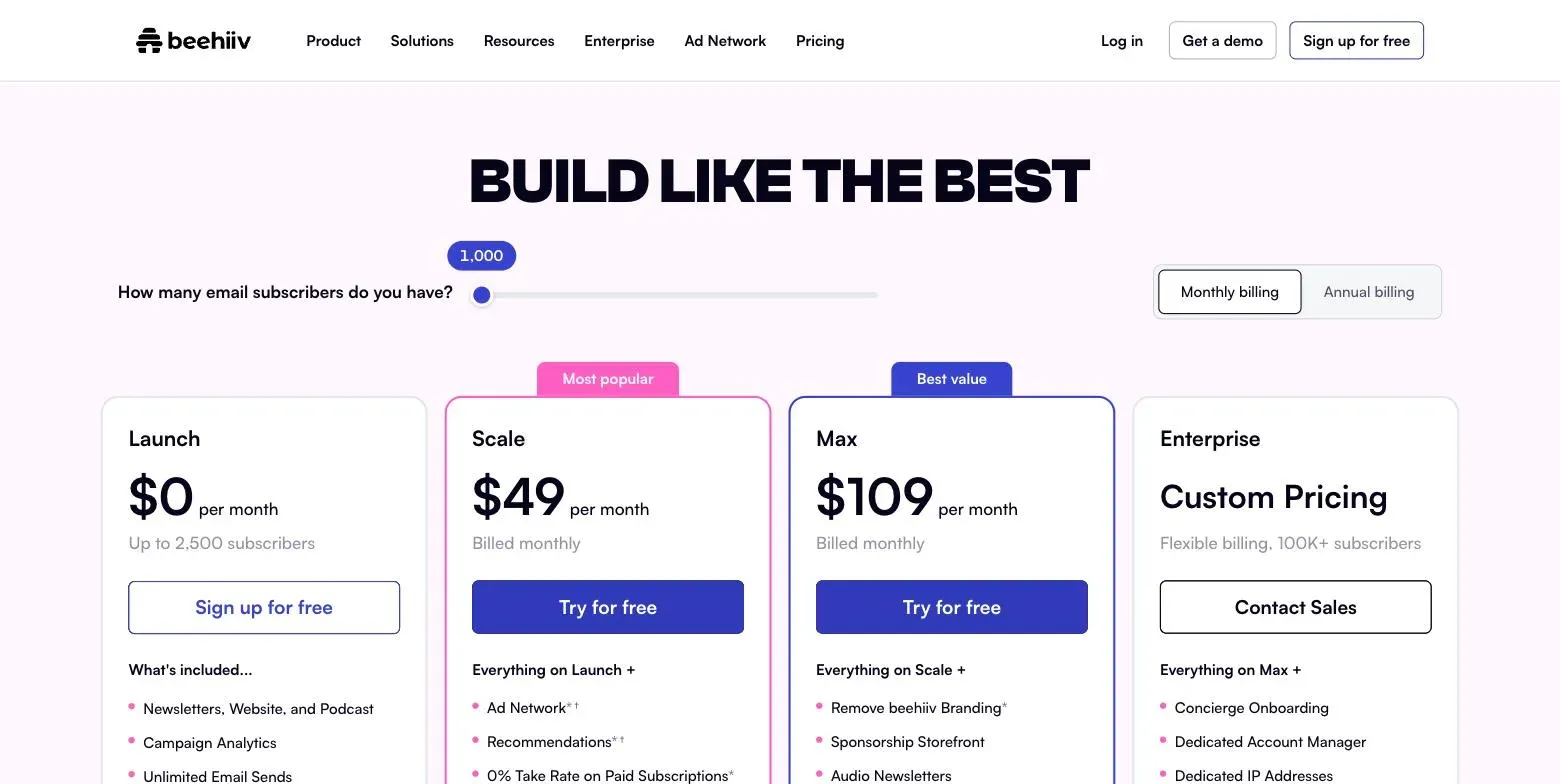
— but it climbs more gently than anything else we compared: $89 at 5,000 and $169 at 25,000, a 3.4× rise across a range where MailerLite multiplies 9.4×. Expensive first, cheap later, which happens to be exactly the profile you want in a tool you’re moving a growing paid newsletter onto. The full six-way pricing picture is in our creator email comparison.
Signing up was the most transparent flow of the five tools we opened accounts on. It offers a 14-day trial of the paid features and states, on the signup screen itself, what happens when it ends — you’re moved to the free Launch plan, not billed:
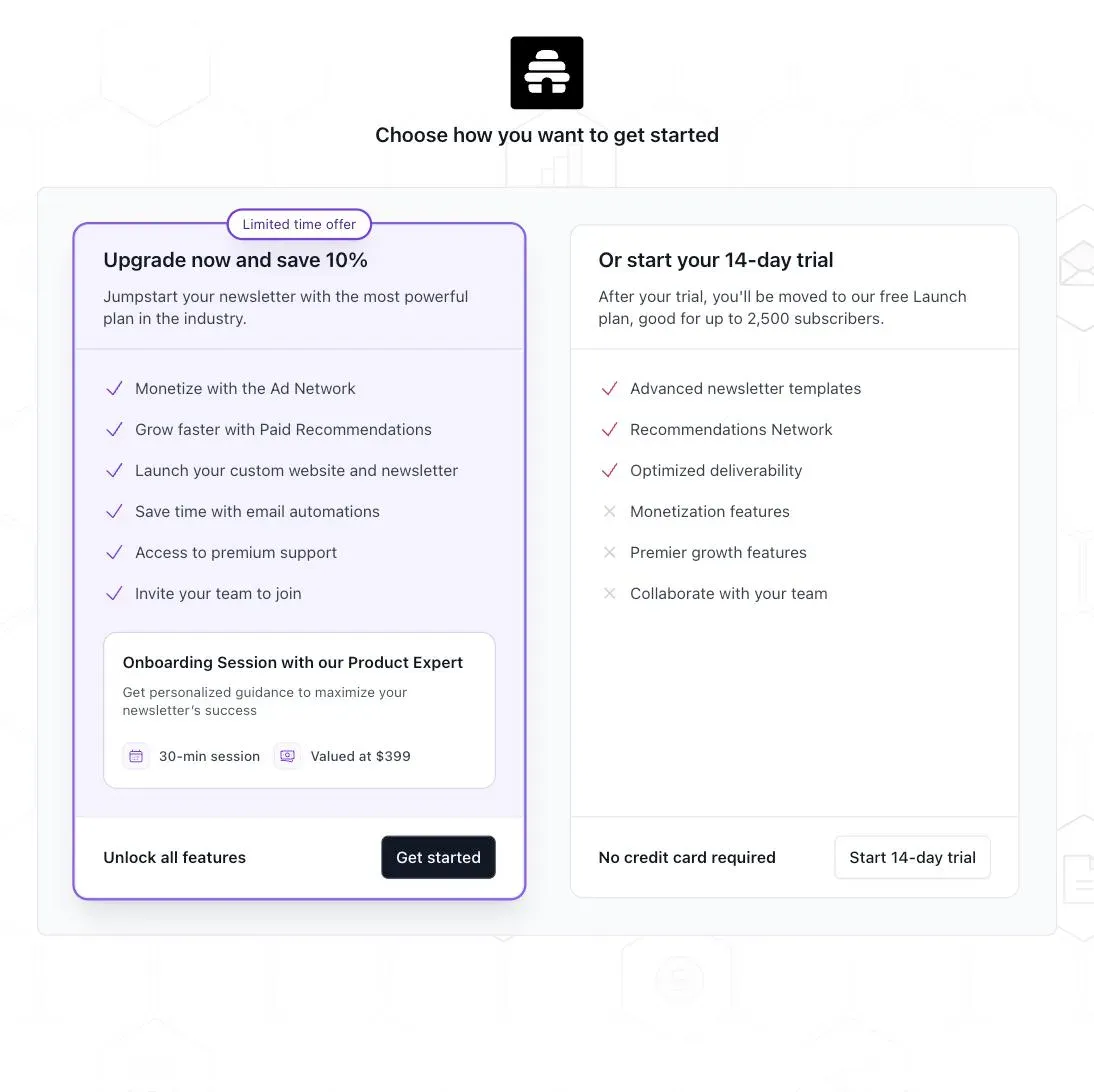
No card, no gotcha, and a built-in Substack import on the way in.
Free to 2,500 subscribers with no card, and signing up through that link adds 20% off for three months if you do end up on a paid plan.
Kit: for the writer who sells things
The second reason people leave Substack has nothing to do with the 10%: Substack is a publishing platform, not a marketing one. It sends what you write, when you write it, to everyone who subscribes. What it doesn’t do is the machinery a creator selling a course or a digital product leans on — tagging readers by what they clicked, branching welcome sequences, delivering a lead magnet and then nurturing toward a launch.
If that’s why you’re leaving, the 10% may be irrelevant (Substack takes nothing from product sales you make elsewhere) and the crossover table above isn’t your decision. Capability is. And the capability-shaped alternative with the friendliest price for a small list is Kit — because its free plan holds 10,000 subscribers, which is 4× beehiiv’s free cap and 40× MailerLite’s.
The catch is what the free tier withholds: automation beyond one basic sequence. One linear welcome series is fine; the moment buyers and browsers need different treatment, you’re on the $39 Creator plan. We’ve mapped exactly where that line falls in Kit vs MailerLite.
Two things we hit in our own account are worth knowing. Kit’s pricing page makes the free plan easy to misread as uncapped — drag the slider past 10,000 and the card still shows “$0 /mo”, greyed out, with the ceiling stated only in the button underneath:
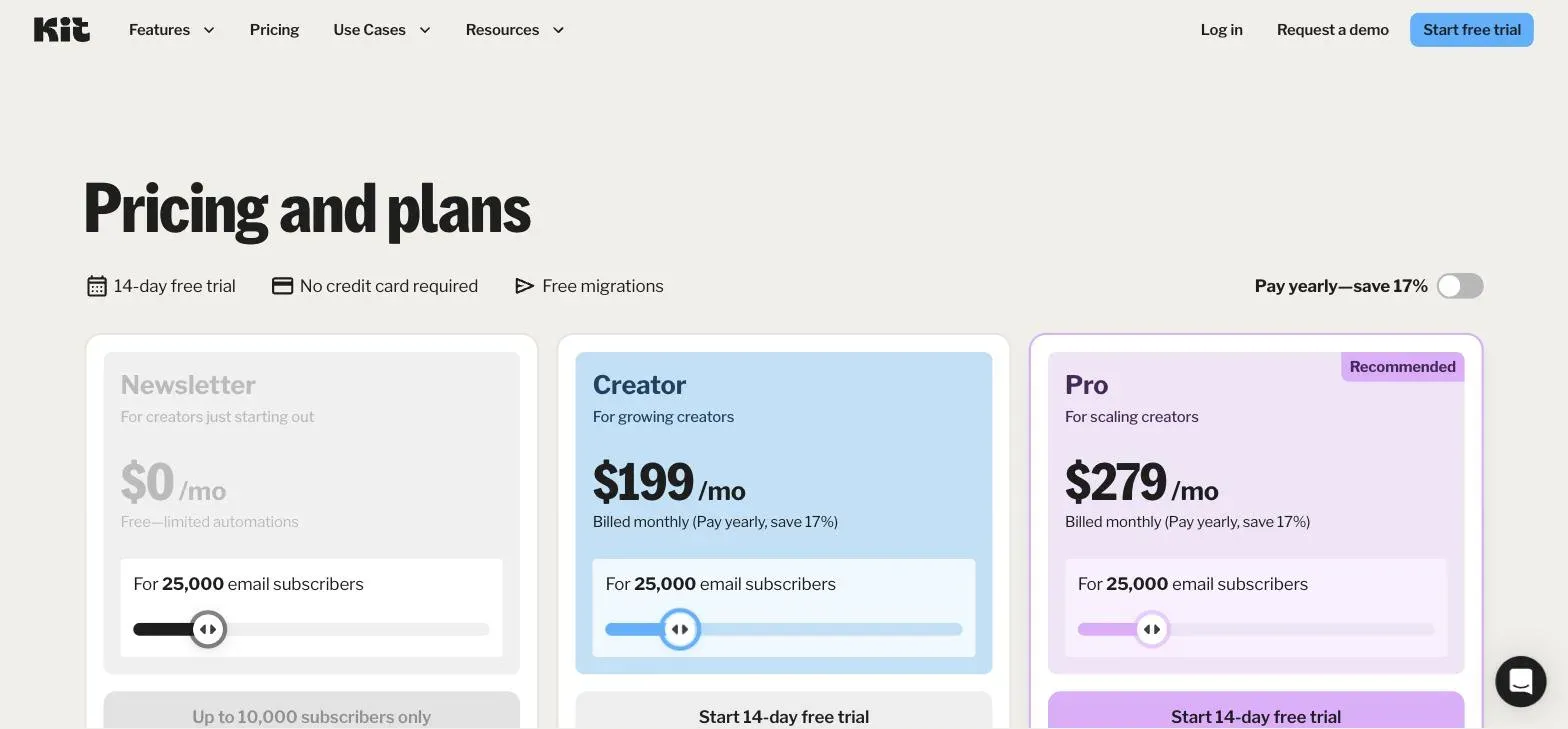
And signup lands you on a 14-day trial of the paid Creator plan, not the free plan — the free tier is there, but you have to deliberately downgrade into it. No card is taken, so the worst case is surprise, not billing.
For paid subscriptions specifically, Kit is a weaker Substack replacement than beehiiv — that’s not what it’s built around. For a free newsletter that funds itself by selling products, it’s arguably the strongest free tier in email. (If the product-selling side is the whole point, our guide to selling digital products without a website covers that stack.)
MailerLite: the budget full-toolkit option
MailerLite is what you pick when you’ve decided you need real email marketing — full automation, forms, landing pages — and want the smallest possible invoice for it. Its entry plan was the joint-cheapest contact-priced tier we measured: $19 a month at 1,000 subscribers, roughly half of Kit at every size we checked, with the full feature set on every paid plan.
The trade-offs are the mirror image of Kit’s. The free plan is an evaluation sandbox, not a runway — 250 subscribers and 2,500 emails a month. And the price curve is steep: $49 at 5,000 and $179 at 25,000, a 9.4× climb that turns the budget pick at 1,000 subscribers into one of the dearer options at 25,000.
Like Kit, signup put us on a 14-day trial of a paid plan rather than the free tier — MailerLite at least labels it clearly in the sidebar from the first screen:
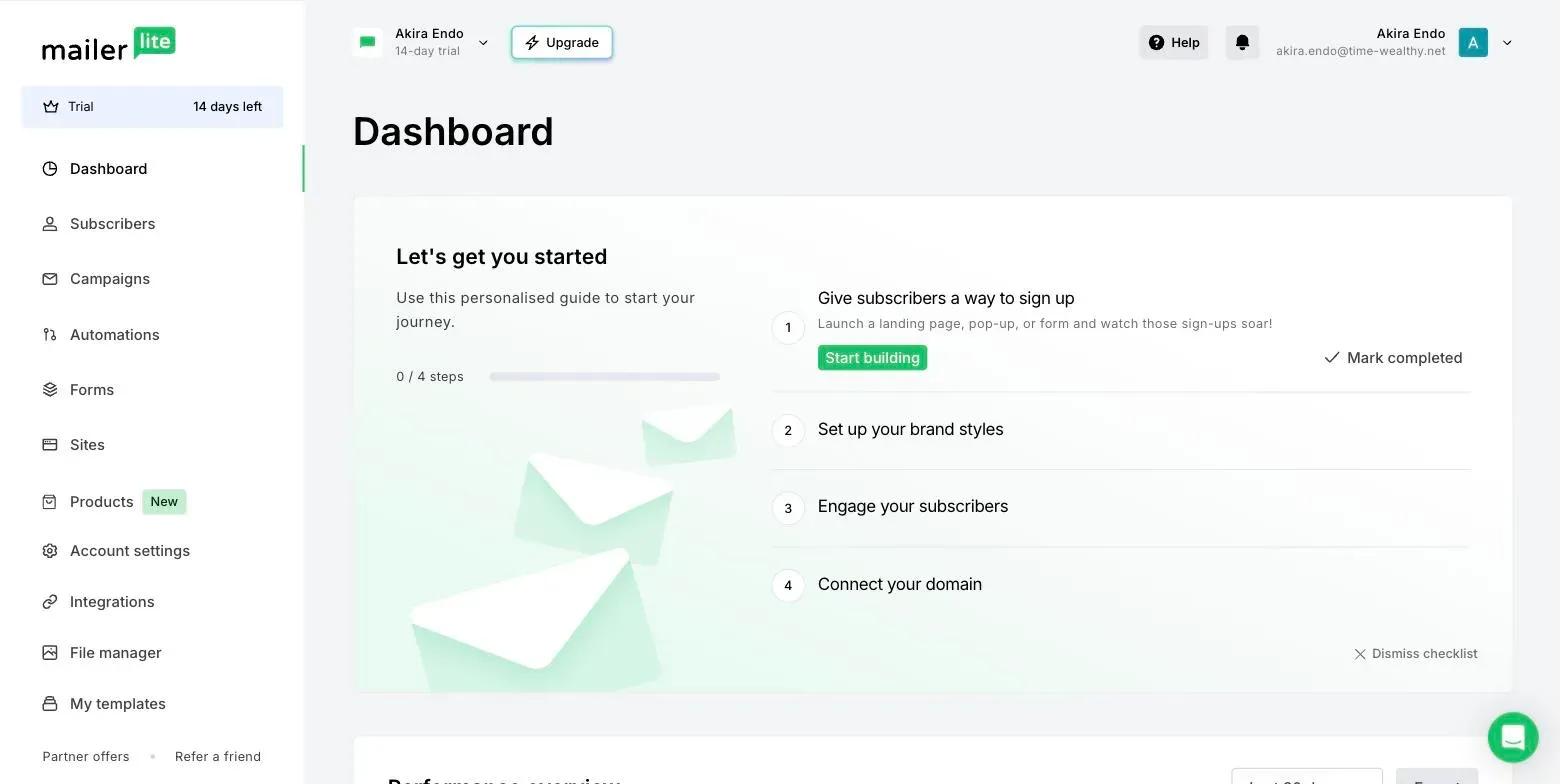
As a Substack replacement it’s the least like-for-like of the three: no publication network, no built-in discovery, paid-newsletter mechanics assembled from parts rather than native. It earns its place here on price alone — the cheapest way to own your list with the full toolkit — and falls out of the running if built-in monetisation or discovery is what you came for.
What you give up by leaving
A fair comparison has to count Substack’s other side of the ledger, because three of its assets don’t migrate.
Discovery. Substack’s recommendation network, reader app and Notes send new readers to publications at zero cost. beehiiv’s recommendation system is the closest analogue, but the graph is younger and skews toward business and media newsletters. Kit and MailerLite have nothing equivalent — every new reader is one you found yourself.
Zero operations. On Substack, payments, tax forms, hosting, deliverability and the paywall are somebody else’s job, permanently. On the alternatives you’ll connect your own Stripe, configure the paywall, and own the settings. It’s hours, not weeks — but it’s yours now.
Simplicity as a feature. There is no plan picker on Substack, no subscriber-count anxiety, no annual-vs-monthly decision. If admin overhead is the thing that kills your publishing habit, a 10% rake you never think about can be worth more than the money.
What does migrate cleanly: your list (every tool here imports a Substack CSV; beehiiv has a dedicated importer) and your archive. What migrates with friction: paid subscribers, whose billing relationships need re-establishing on your own Stripe — plan that step before you announce anything.
The short version
- Free newsletter, plan to stay free → stay on Substack. $0 at any scale is the whole argument, and nothing here beats it.
- Paid newsletter under ~49 paying readers (at $10/month, 1,000-list sizing) → also Substack. The 10% is cheaper than any flat fee at this size, and the discovery network is doing you free favours.
- Paid newsletter past the crossover, or growing toward it → beehiiv Scale. Flat fee, 0% take, the gentlest price curve we’ve measured, and the only alternative with Substack’s publication-and-discovery shape.
- Free newsletter that sells products → Kit’s free plan to 10,000 subscribers, upgrading only when one automation stops being enough.
- Full email marketing on the smallest budget → MailerLite at $19 — accepting the steep curve and the DIY monetisation.
| Monthly cost | Cut of paid revenue | Free tier | Paid subs on free tier | |
|---|---|---|---|---|
| Substack | $0 | 10% + Stripe | Unlimited | Yes |
| beehiiv (Scale) | $49–$169 | 0% + Stripe | 2,500 subs | No |
| Kit (Creator) | $39–$199 | n/a (external) | 10,000 subs | n/a |
| MailerLite (Comfort) | $19–$179 | n/a (external) | 250 subs | n/a |
Prices as measured on each vendor’s calculator, monthly billing; check current pricing before committing.
The honest summary is that Substack’s 10% is neither a scandal nor a bargain — it’s a loan against your future revenue, generous while you’re small and increasingly expensive as you grow. Work out your paying-reader count, find your row in the crossover table, and the decision mostly makes itself.