How to Sell Digital Products Without a Website
“I need to build my website first” has probably delayed more digital product launches than any other sentence. It feels responsible. It’s actually a detour: to sell an ebook, a template pack, a mini-course, or a coaching slot, you don’t need a website. You need exactly three things — a page that sells, a checkout that takes money, and an email that delivers the product. Everything else can come after revenue.
This guide walks through the exact minimum stack, using the setup we built ourselves on a free plan — screenshots included — plus the honest trade-offs of skipping the website, and the moment when you should finally build one.
Some links in this article are affiliate links — see our affiliate disclosure. It doesn’t change what we recommend.
The three-piece minimum stack
Strip away the software marketing and every digital product sale needs the same plumbing:
- A landing page — one URL that explains the product and asks for the sale (or the email address, if you’re building a list first).
- A checkout — a payment form connected to Stripe or PayPal. Not a shopping cart, not a store: one product, one button.
- Delivery — an automated email that sends the file, the course access, or the booking link the moment payment clears.
A website — navigation, blog, about page, portfolio — is none of these. It helps later (we’ll get to when), but it converts almost nothing by itself. Buyers arrive on one page from one link you shared; that page does the whole job.
The $0 route we actually built
Any modern funnel tool can assemble the three pieces. We used systeme.io’s permanently free plan because it’s the only one where the whole stack costs nothing — 3 funnels, 1 course, 2,000 contacts, unlimited email sends, 0% transaction fees, no card at signup — and because we wanted to verify the “minutes, not weeks” claim ourselves. From a blank account to an editable, connected funnel took us under ten minutes.
Here’s the build, step by step.
Step 1: Create a funnel, not a website
After signup, go to Funnels → Create. You’ll name the funnel and choose a goal — “Build an audience” for a lead magnet, or “Sell” for a paid product. Pick the goal that matches your offer; the tool scaffolds the right page sequence automatically. Ours generated an opt-in page wired to a thank-you page with no assembly:
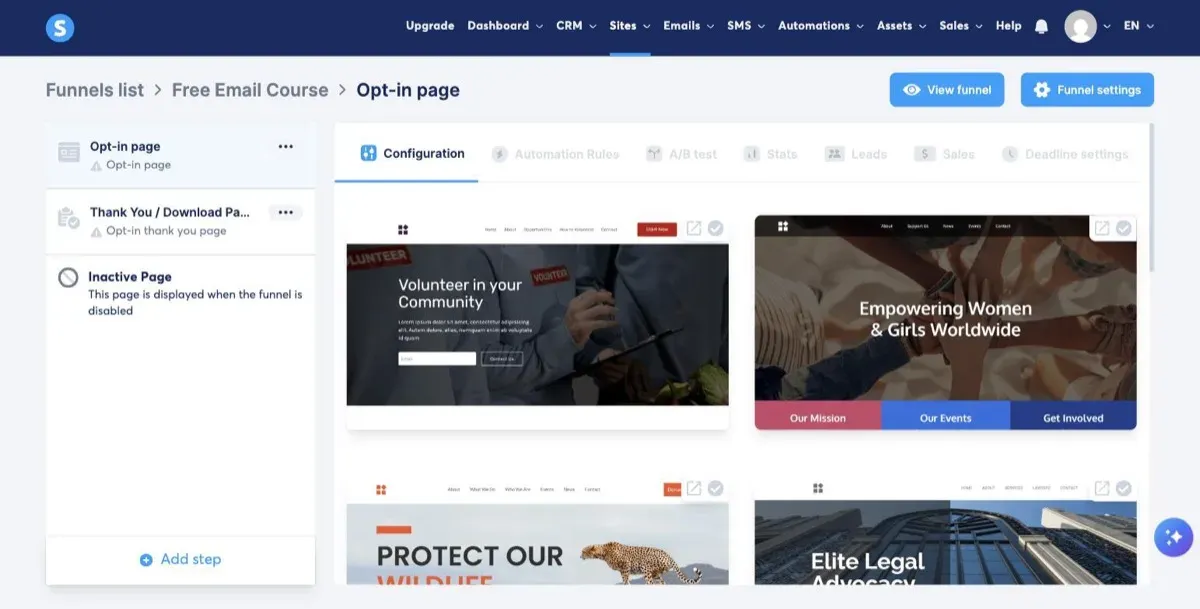
That scaffolding is the entire point of skipping the website: the structure decisions (what pages, in what order, linked how) are already made.
Step 2: Pick a template and make it yours
Each step opens a template gallery; pick one and you’re in a block editor — text, images, forms, and columns on the left, your live page on the right:
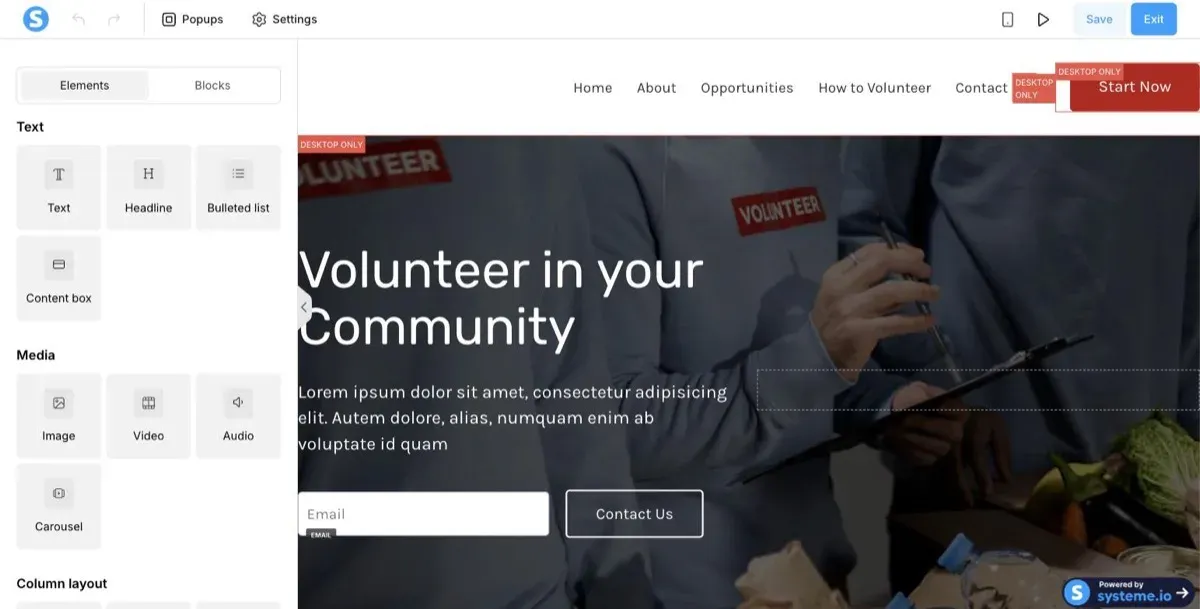
Resist redesigning. Change five things and ship: headline (the outcome your buyer gets), one paragraph of proof or specifics, the price, the button text (“Get the template pack” beats “Submit”), and your product image. A focused ugly page outsells a beautiful unfinished one that never launches.
Step 3: Connect the money
In settings, connect Stripe or PayPal (systeme.io supports both on the free plan, and takes 0% on top — you pay only the processor’s standard fees). For a paid funnel, attach your price to the checkout step. For a lead magnet, skip this — the “payment” is an email address.
Step 4: Automate the delivery
Attach an automation rule to the funnel: on purchase (or signup), send an email containing the file link or course access. One rule, one email — this is the piece that makes the machine run without you. The free plan includes email automation and unlimited sends, so delivery costs nothing per sale.
Step 5: Share one link
Your funnel lives at a hosted URL (a free custom domain is included if you want offers.yourname.com instead of a subdomain). That link is your storefront: put it in your social bios, your posts, your email signature, your podcast notes. You’re live:
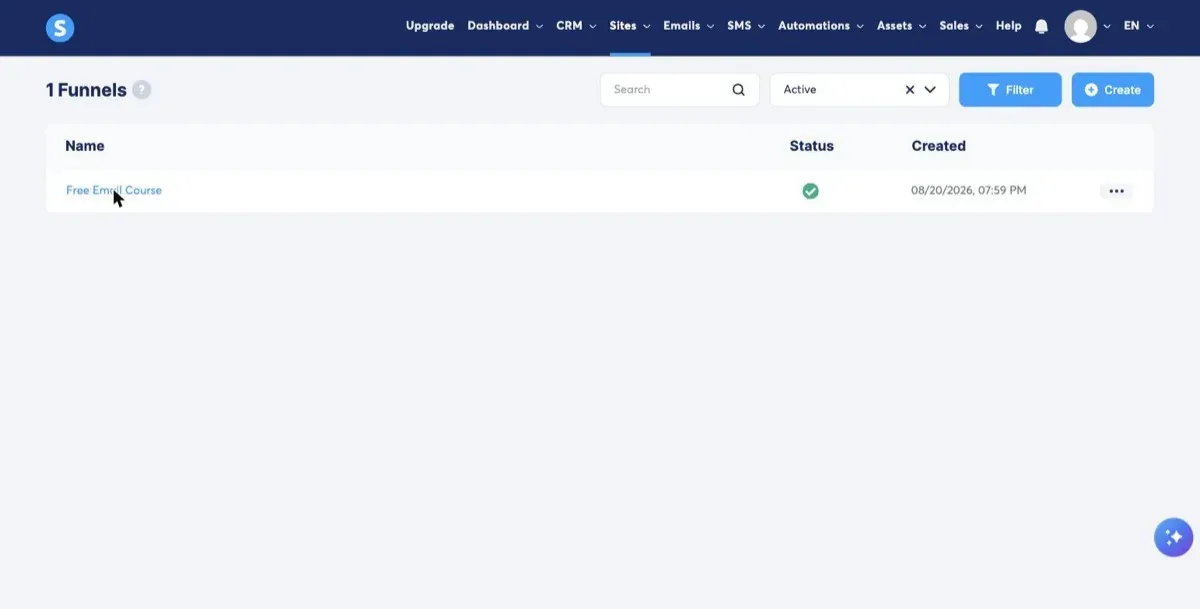
Two honest notes from our build: free-plan pages carry a small “Powered by systeme.io” badge, and the template polish is a tier below premium tools — acceptable trade-offs at $0, and both disappear on paid tiers ($17–97/mo) if the product earns its keep.
Price it before you build it
Your price decides which tools are even eligible, because platform fees hit cheap products hardest. Take a $19 template pack and watch the same sale shrink on different stacks (platform fees only; Stripe/PayPal’s ~2.9% + 30¢ applies roughly everywhere on top):
| Stack | Platform fee on a $19 sale | You keep (before processing) |
|---|---|---|
| systeme.io (any plan) | 0% → $0.00 | $19.00 |
| Podia Mover | 5% → $0.95 | $18.05 |
| Teachable Starter | 7.5% → $1.43 | $17.57 |
| LearnWorlds Starter | flat $5 per enrollment → $5.00 | $14.00 |
At $19, LearnWorlds’ flat fee is an effective 26% — the same fee on a $300 course would be under 2%. The lesson generalizes: percentage fees punish volume, flat fees punish cheap products, and 0% platforms make low-ticket experiments viable at all. If you’re testing a $9–29 product, start where the platform takes nothing; if you graduate to premium pricing, the fee column stops mattering and features decide.
While you’re at it, resist the classic first-timer prices. $47 with three bonuses is a launch-bro cliché that reads as such; $5 signals “worthless” for anything with real effort in it. For a first digital product, the $15–39 band is where impulse purchase psychology still works and the revenue is real enough to validate demand.
The delivery email is half the product
The automated email from Step 4 deserves more craft than most people give it — it’s the only guaranteed touchpoint with a paying customer. Four rules from the emails that don’t generate refund requests:
- Send it instantly, and say so on the thank-you page. “Check your inbox — it’s already there” kills the did-it-work anxiety that drives support messages and disputes.
- The download link goes in the first two lines. Not after a welcome essay. People opened this email to get the thing; give them the thing, then talk.
- Set expectations for the file. Format, size, how to open it, where to save it. One sentence prevents half your support email.
- One soft next step, no more. A single line — “When you’ve used this, here’s the natural next thing” — pointing at your other product or your list. A delivery email with three upsells reads as a trap and poisons the goodwill the purchase just created.
Write this email before you finish the landing page. If you can’t describe the deliverable crisply in the email, the product isn’t ready to sell yet — cheaper to learn that on day one.
The one-evening launch plan
The build is genuinely an evening if you sequence it so the writing — the real work — comes first:
- First hour — write, no software. Headline (the outcome, not the product), five bullet points of what’s inside, the price, and the delivery email. In a plain text file.
- Second hour — assemble. Create the funnel, pick a template, paste your text over the placeholder copy, upload one product image. Change nothing else about the design.
- Third hour — wire and test. Connect Stripe or PayPal, attach the delivery automation, then buy your own product with a real card. Check the email arrives, the link works, the file opens. Refund yourself through the processor dashboard.
- Ship before you sleep. Put the link in your bio and post once about it. Not a launch campaign — a door quietly opened. The point of the no-website route is that iteration is now free: tomorrow you can change the headline in two minutes and see if anything different happens.
The failure mode to avoid isn’t building it wrong — everything above is reversible. It’s spending the evening comparing tools instead of writing the five bullet points. The stack is a solved problem; the offer is yours to solve.
Other ways to run the same play
The three-piece stack is tool-agnostic. Depending on what you’re selling, these run the same play with different strengths — all covered in depth in our comparison articles:
- Podia — if your “product” is really a small catalog (a course, some downloads, a coaching offer), Podia bundles storefront-style product pages with checkout and delivery, and its 30-day trial needs no card. Simpler than funnels, less marketing machinery. See our course platform comparison.
- GetResponse — if the email list is the strategy and the product comes later, its free plan (500 contacts) covers landing pages and email; funnels arrive on paid tiers. Email depth is its edge.
- Kajabi — the premium version of this entire article in one subscription ($179/mo): funnels, unlimited email, courses, checkout. Overkill before revenue; sensible once an email-driven product business is working. Our Kajabi alternatives guide maps when it’s worth it.
- ClickFunnels — deepest funnel optimization tooling ($97/mo) once you’re buying traffic and tuning conversion. Wrong first tool, right fifth tool. See the funnel builder comparison.
What skipping the website costs you — honestly
The no-website route trades three real things for speed:
Search traffic. One landing page won’t rank for anything meaningful. If your growth plan is SEO, you’ll need content on a real site eventually — the funnel handles conversion, not discovery. Your traffic must come from somewhere you already are: social, communities, a podcast, partnerships, your existing list.
Trust signals. Buyers who research before buying look for an about page, more products, some evidence of a real operation. A single page with a working checkout is fine for low-ticket impulse-friendly products ($5–50); for a $500 offer, thin presence costs conversions.
A home for later. Every funnel link you share points at a URL you should keep forever. Use a custom domain from day one — even on the free plan — so that when you do build a site, your links and any accumulated authority move with you instead of dying on a subdomain.
When to graduate to a real website
The signal isn’t time — it’s repetition. Build a website when any of these becomes true: you have three or more products and people ask what else you sell; you’re writing content anyway and want search traffic to compound; or your price point has climbed to where buyers do homework before purchasing. At that point the funnel doesn’t get replaced — it becomes the checkout layer behind a site that does discovery and trust. The work you did in this guide stays load-bearing.
Frequently asked questions
Can I really take payments without a business website? Yes. Stripe and PayPal require accurate business information at their signup, not a website. The funnel page satisfies the “where do you sell” question for a digital product.
What about taxes and invoices? The processor handles receipts; tax obligations follow your local rules regardless of whether a website exists. If you sell into the EU at volume, look at your VAT position early — some platforms (Podia among them) handle sales-tax collection for you, which is a legitimate reason to pick one over a bare funnel.
Is a Linktree-style page enough instead? It solves link-sharing, not selling — no checkout, no delivery, no email capture worth the name. It’s a table of contents; this stack is a store.
How fast is “fast,” really? Our timed build — blank account to a working, editable funnel — was under ten minutes, with most of it spent browsing templates. Budget an evening for a real product: the writing (headline, proof, delivery email) takes longer than the software.
Bottom line
The minimum viable product business is one page, one checkout, one delivery email — and every piece of it now costs $0 to run. Build the funnel tonight, share one link tomorrow, and let actual sales tell you whether the product deserves a website. Start free, and spend your effort on the offer, not the infrastructure.