Best Sales Funnel Builders for Small Business: 4 Tools Compared
A sales funnel is simple in theory: a landing page, an email sequence, a checkout, maybe an upsell. What’s not simple is the software bill. Do it with point solutions and you’re paying for a landing page builder, an email tool, a checkout provider, and something to glue them together — four subscriptions, four logins, and an integration diagram before you’ve sold anything.
Funnel builders promise to collapse that stack into one product. But the four big names — systeme.io, ClickFunnels, GetResponse, and Leadpages — take strikingly different approaches, and one of them isn’t really a funnel builder at all anymore. Their entry prices range from $0 to $97/month, and the cheapest and most expensive options are not the ones most comparison articles would lead you to expect.
All pricing here comes directly from each vendor’s official pricing page. Prices change; confirm on the vendor’s site before committing.
Some links in this article are affiliate links — see our affiliate disclosure. It doesn’t change what we recommend.
Three questions that actually decide it
1. What does it replace? The whole point of a funnel builder is deleting other subscriptions. A tool that includes email marketing, checkout, and course hosting can genuinely replace three products. A tool that only builds pages leaves you paying for the rest of the stack. Score each candidate by the subscriptions it removes, not the features it lists.
2. What does it cost at your contact count? Every all-in-one tool prices primarily on contacts (your email list size). The ranking of “cheapest” changes completely between 1,000 contacts and 25,000 — we’ve priced this out below, because it’s the single most decision-relevant table in this comparison.
3. Can you start free — actually free? Two of the four have permanent free plans, one has a short trial that requires a credit card, and one has a two-week trial. If you’re bootstrapped, the difference between “free until it works” and “$97/month while you figure it out” is the difference between testing an idea and betting on it.
Quick comparison
| Entry price (monthly) | Free plan | Email marketing | Funnels | Transaction fee | |
|---|---|---|---|---|---|
| systeme.io | $17 (Startup) | Yes — permanent (2,000 contacts, 3 funnels, 1 course) | Yes, unlimited sends on every plan | Yes (3 → 10 → 50 → unlimited) | 0% |
| ClickFunnels | $97 (Launch) | No — 14-day trial + 30-day money-back guarantee | Yes, with send caps (50k/mo on Launch) | Yes, unlimited on all plans | 0% |
| GetResponse | $19 at 1,000 contacts (Starter) | Yes — permanent (500 contacts, 2,500 sends/mo) | Yes — its core strength | On Marketer plan ($59) and up, not Starter | 0% on course sales (Creator+) |
| Leadpages | $10 (HTML Pub Starter) / $99 (Grow) | No — 7-day trial, credit card required | No — none | Landing pages only | Not published |
Two of these numbers deserve an immediate flag. GetResponse’s $19 Starter plan does not include its funnel feature — funnels start on the $59 Marketer plan. And Leadpages has no email marketing at all; it’s a landing page and conversion-optimization tool that expects you to connect an external email provider. Neither fact is obvious from the headline pricing.
systeme.io: the bootstrapper’s default
systeme.io’s free plan is the standout offer in this market: 2,000 contacts, 3 funnels, 1 course, 1 community, unlimited email sends, and 0% transaction fees — permanently, with no credit card. Every competitor’s “free” is a trial; this one is a plan you could genuinely launch a first product on.
The paid tiers stay aggressive. Startup ($17/mo) raises you to 5,000 contacts and 10 funnels; Webinar ($47/mo) adds evergreen webinars and 50 funnels; Unlimited ($97/mo) removes essentially every cap — the same price point where ClickFunnels starts.
The all-in-one scope is the widest of the four: funnels, email campaigns, landing pages, blogs, online courses, communities, an affiliate program manager (included even on the free plan — unusual at any price), booking calendars, and physical product sales. Email sends are unlimited on every tier; only contact count is metered. Combined with 0% transaction fees, the real cost of running systeme.io is unusually predictable.
The trade-offs are depth and polish. Funnel counts are capped below the top tier (the pricing table says 10 on Startup and 50 on Webinar, though systeme.io’s own FAQ describes these tiers more generously — when a vendor’s page contradicts itself, budget on the stricter number). Automation is limited on the lower tiers (1 automation rule and workflow on Free, 10 and 5 on Startup). And its webinars are evergreen (pre-recorded, auto-scheduled) rather than live.
Strengths: only genuinely free entry point in the category; unlimited email sends at every tier; widest all-in-one scope; 0% fees; $97 ceiling where competitors are just getting started.
Weaknesses: funnel and automation caps below the Unlimited tier; no live webinars; less polished template ecosystem than ClickFunnels.
If budget is your binding constraint, start on the free plan and let revenue justify the upgrades.
What the free plan is actually like (we signed up)
We created a free systeme.io account while writing this comparison, so the claims above are tested, not copied from the pricing page. Signup took an email address and a password — no card, exactly as advertised.
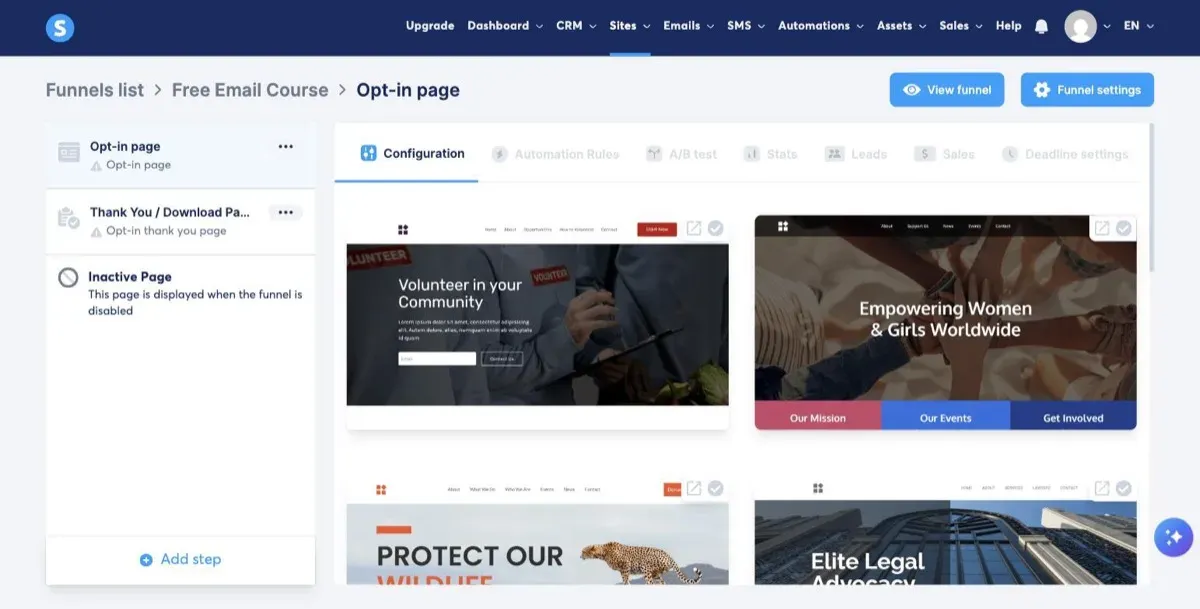
The part that impressed us: choosing “Build an audience” as the funnel goal scaffolds a working two-step funnel automatically — an opt-in page and a thank-you/download page, pre-wired together — and then asks you to pick a template for each step. From a blank account to an editable funnel took us under ten minutes, most of it browsing templates.
Each page opens in a block-based drag-and-drop editor — elements (text, media, forms, columns) on the left, live page on the right. It’s closer to a simple website builder than to ClickFunnels’ more elaborate canvas, which for a first funnel is a feature, not a limitation.
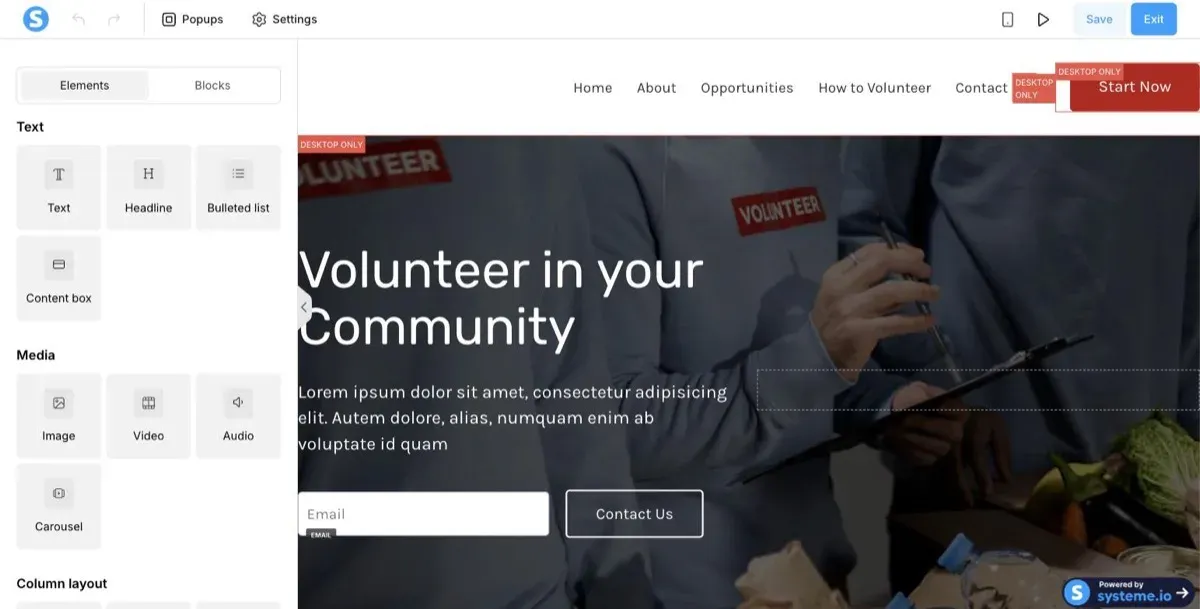
Two honest observations from the trial. First, pages on the free plan carry a “Powered by systeme.io” badge in the corner — expected at $0, but know it’s there before you send paid traffic to the page. Second, the funnel lives on a systeme.io subdomain until you connect a custom domain (the free plan includes one).
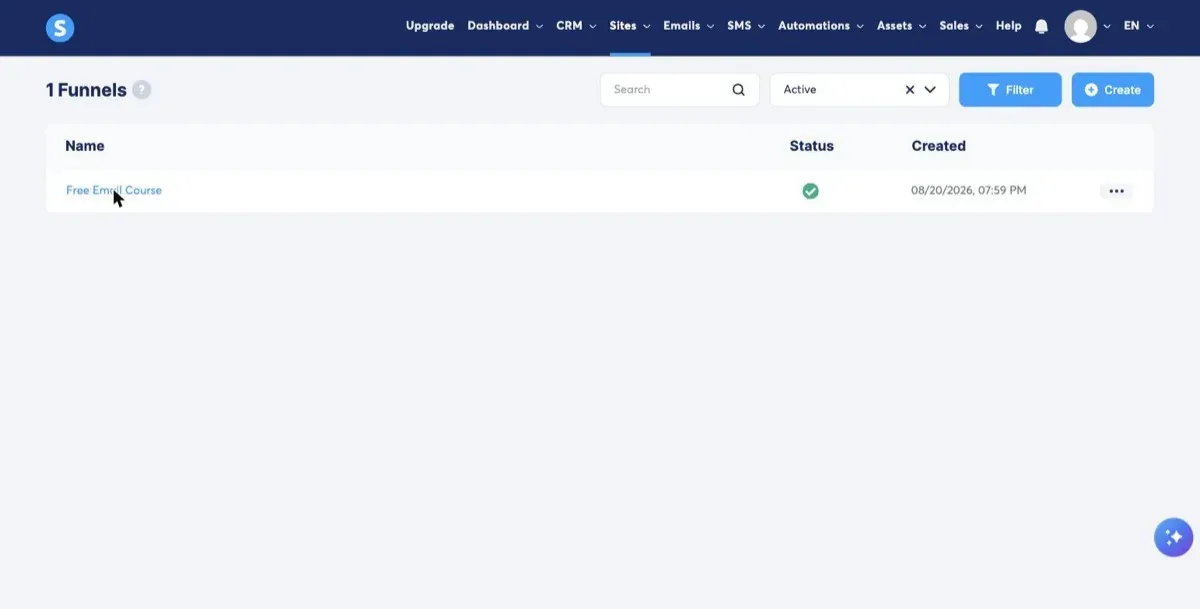
No card, and the free plan doesn’t expire — you can build the funnel above before deciding whether any of this is worth paying for.
ClickFunnels: the premium funnel specialist
ClickFunnels invented much of the modern funnel vocabulary, and its current platform (Launch $97/mo, Scale $197/mo, Optimize $297/mo) reflects that heritage: unlimited funnels and pages on every plan, an AI funnel builder, A/B testing, smart checkout, countdown funnels, plus courses, communities, stores, and appointment booking bolted on over the years.
The pricing puts it in a different bracket than the other three, and the plan gating deserves attention. Launch caps email at 10,000 contacts and 50,000 sends per month — workable, but marketing automations don’t arrive until Scale ($197/mo), and the affiliate center not until Optimize ($297/mo). Both of those come standard (in some form) on systeme.io’s free plan. What you’re paying for instead is the funnel-building depth: the template library, the A/B testing culture, the checkout optimization tooling, and a large ecosystem of training and community around the product.
There’s no permanent free plan — a 14-day trial plus a 30-day money-back guarantee. ClickFunnels charges no percentage of your sales (“you’ll keep every penny,” per its own FAQ), which matters at this price point: the subscription is the whole cost.
One practical warning: ClickFunnels’ website still has an older pricing page floating around with a different plan lineup at different prices. The current plans are Launch / Scale / Optimize on the main pricing page — if you see “Basic” or “Funnel Hacker” tiers quoted somewhere, you’re reading stale information.
Strengths: unlimited funnels on every plan; deepest funnel-specific tooling and template ecosystem; strong checkout and A/B testing; no transaction fees.
Weaknesses: starts at $97/mo where systeme.io ends; automations and affiliate tools gated to $197+/mo tiers; email caps on lower plans; no free plan.
If you want to evaluate it, plan around the 14-day trial — it’s enough time to build one real funnel, not three.
GetResponse: the email platform that grew funnels
GetResponse comes at funnels from the opposite direction: it’s an email marketing platform first, and it shows — in the good and bad senses.
The good: its email tooling is the deepest of the four. Autoresponders, drip campaigns, send-time optimization, contact scoring, dynamic segmentation, spam testing, custom DKIM — features the other three either lack or implement shallowly. Every paid plan includes unlimited sends and unlimited landing pages. It’s also the only tool here with live webinars built in (up to 100 attendees on the Creator plan), where systeme.io offers only evergreen replays and ClickFunnels none at all. And there’s a permanent free plan: 500 contacts and 2,500 sends a month — small, but a real way to test the product.
The catch: pricing scales with list size, and the funnel feature isn’t on the entry plan. Starter at $19/mo (for 1,000 contacts) covers email, landing pages, and popups — but Conversion Funnels, abandoned-cart recovery, and e-commerce tracking all start on Marketer ($59/mo). So the honest comparison price for GetResponse as a funnel builder is $59, not $19. From there, list growth moves the number: $114/mo at 10,000 contacts, $215/mo at 25,000.
Strengths: best email marketing of the four by a wide margin; live webinars built in; permanent free plan; unlimited sends and landing pages on paid tiers.
Weaknesses: funnels require the mid-tier plan; costs climb steadily with list size (more on that below); no affiliate program manager for your own products.
The free plan is the low-risk way in, with a 14-day taste of the premium features when you sign up.
Leadpages: not a funnel builder — know what you’re buying
Leadpages appears on every funnel-builder list, but the current product has repositioned into something more specific: a landing page and conversion-optimization platform. There is no email marketing in it at all. You collect leads on Leadpages and push them via integrations (Mailchimp, HubSpot, and about 200 others) to whatever actually sends your email.
Read that as disqualifying and you’ll miss what it’s good at. The lineup splits into two products: HTML Pub (from $10/mo — publish up to 5 pages on a custom domain) and the full Leadpages platform (from $99/mo) with unlimited pages, unlimited traffic, and the conversion tooling that is its real differentiator — A/B testing from the entry tier, and on higher tiers AI-driven traffic splitting, heatmaps, and automatic personalization. All plans include unlimited traffic, which its landing-page competitors meter.
For a small business that already has an email tool it likes, “just give me high-converting pages” is a legitimate brief, and Leadpages’ $10 entry is the cheapest way in this comparison to get a page live on your own domain. But as your funnel’s system of record, it can’t stand alone.
One friction point worth knowing before you test it: the trial is 7 days and requires a credit card up front (you’re charged on day 7 unless you cancel). That’s the least generous evaluation window of the four.
Strengths: cheapest paid entry ($10/mo); unlimited traffic on all plans; serious conversion-optimization tooling (A/B tests, AI traffic splitting, heatmaps); fits an existing stack instead of replacing it.
Weaknesses: no email marketing whatsoever; no course hosting; full platform starts at $99/mo; card-required 7-day trial.
If pages are all you need, the trial will tell you quickly — just diary the cancellation date.
The table that settles it: cost at your list size
Because contacts drive pricing everywhere, here’s the cheapest plan that holds your list on each all-in-one tool, at monthly billing. (Leadpages is excluded — it doesn’t price by contacts, and you’d be adding an email tool’s cost on top.)
| Contacts | systeme.io | ClickFunnels | GetResponse (with funnels) |
|---|---|---|---|
| 2,000 | $0 (Free) | $97 (Launch) | $69 (Marketer, 2.5k) |
| 5,000 | $17 (Startup) | $97 (Launch) | $95 (Marketer) |
| 10,000 | $47 (Webinar) | $97 (Launch) | $114 (Marketer) |
| 25,000 | $97 (Unlimited) | $197 (Scale) | $215 (Marketer) |
| 100,000 | $97 (Unlimited) | $297 (Optimize) | $599 (Marketer) |
systeme.io is the price leader at every single row — the interesting question is what you’re giving up for that, which is depth (ClickFunnels’ funnel tooling) or email sophistication and live webinars (GetResponse). Note also how differently the tools scale: systeme.io’s cost flattens at $97 while GetResponse’s keeps climbing with your list.
Which one for which business
Bootstrapped, pre-revenue, or testing an offer → systeme.io. Start on the free plan, launch a real funnel, and pay $17 when you outgrow it. No other tool in this category lets you validate an idea for $0.
Funnel-driven business with proven offers → ClickFunnels. If your revenue model is funnels — paid traffic in, optimized checkout out — the depth of testing and checkout tooling can earn back the premium. Buy it for the craft, not the checklist.
Email list is your main asset, and you run webinars → GetResponse. The Marketer plan gives you serious email automation plus funnels; Creator adds live webinars no one else here offers. Just model the cost at the list size you expect in two years, not today.
You only need pages, and your stack already works → Leadpages. The $10 entry or the $99 conversion platform slot into an existing email/CRM setup. Just don’t call it your funnel builder — it’s your page layer.
Selling courses as the main product? The overlap between funnel builders and course platforms is large — our course platform comparison covers that decision from the other side.
Frequently asked questions
Can I really run a business on systeme.io’s free plan? Within its limits — 2,000 contacts, 3 funnels, 1 course — yes, and with unlimited email sends and 0% transaction fees, nothing forces an upgrade except growth. Check the current plan terms when you sign up, as inclusions can change.
Why is ClickFunnels so much more expensive? You’re paying for funnel-specific depth (templates, A/B testing, checkout optimization) and ecosystem, not for scope. systeme.io covers more categories of features for less; ClickFunnels goes deeper on the one that gives it its name.
Do any of these take a cut of sales? systeme.io and ClickFunnels both charge 0% transaction fees on all plans. GetResponse charges 0% on course sales on its Creator tier. Leadpages doesn’t publish a transaction fee figure. Payment processors’ own fees (Stripe, PayPal) apply everywhere.
Bottom line
For most small businesses starting out, the pragmatic path is: validate on systeme.io’s free plan, and only leave it for a specific reason — ClickFunnels if funnel craft becomes your competitive edge, GetResponse if email sophistication and live webinars drive your model, Leadpages if you just need better pages on top of a stack you already trust.
All four let you start without spending anything today except time. Pick the one whose trade-offs match your next twelve months, take the trial, and build one real funnel before you decide.