MailerLite Review: What $19 Buys, and When It Stops Being Cheap
MailerLite’s reputation is one sentence long: it’s the cheap one. That reputation is accurate, incomplete, and — depending on the size of the list you end up with — occasionally the opposite of the truth.
The accurate part: at 1,000 subscribers, MailerLite’s entry plan was the joint-cheapest contact-priced tier we measured across six email tools, at $19 a month, and unlike most of the category it doesn’t hold features hostage to upsell you later. The incomplete part: its price multiplies 9.4× between 1,000 and 25,000 subscribers, one of the steepest curves in email, so the budget pick at the start of your list’s life is one of the pricier options near the top of it.
This review works through what the $19 actually buys, what we ran into using our own account, and the specific list sizes and use cases where MailerLite is the right call — or the wrong one.
We have no affiliate relationship with MailerLite, and there are no affiliate links on this page. Other articles on Cevora do carry them — see our affiliate disclosure.
What we have and haven’t tested. We opened a MailerLite account while researching this category, so the signup findings and screenshots below are from our own dashboard, and every price was read off MailerLite’s own calculator on monthly billing, moving the subscriber slider ourselves. We have not run MailerLite at scale with a real list under send volume, and nothing below pretends otherwise.
The pricing, measured
Monthly billing, read off the calculator at three list sizes:
| Subscribers | Comfort | Power |
|---|---|---|
| 1,000 | $19 | $39 |
| 5,000 | $49 | $69 |
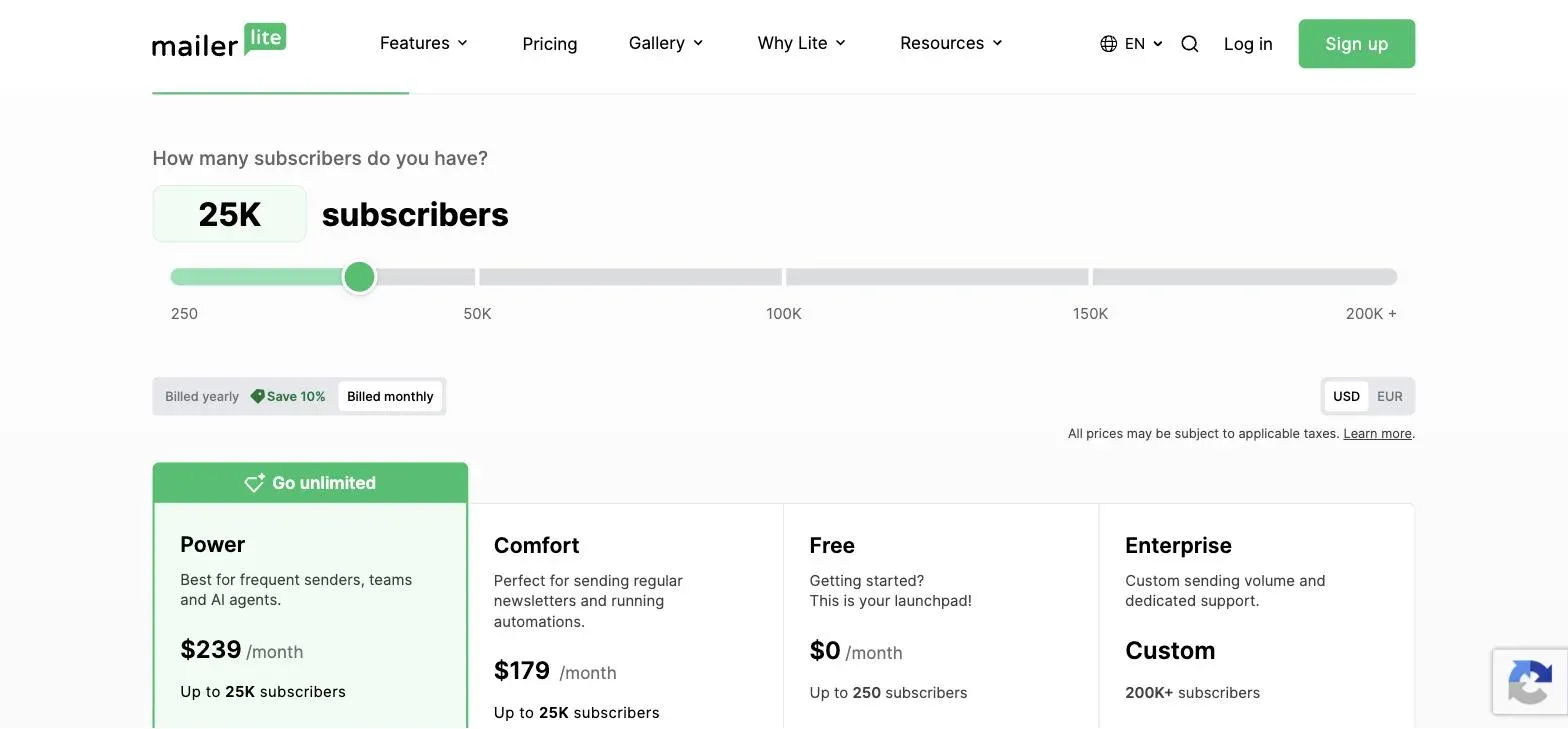
| 25,000 | $179 | $239 |
For calibration against the category: at 1,000 subscribers the other contact-priced tools we measured came in at $14.33 (Mailchimp Essentials), $19 (GetResponse), $39 (Kit) and $49 (beehiiv). Only Mailchimp’s stripped-down Essentials undercuts Comfort, and not by much. The full six-way picture, including where the ordering flips as lists grow, is in our creator email comparison.
Two properties of this table matter more than any single number.
The entry price is honest. Comfort at $19 is not a teaser tier with the good parts removed. Automation, landing pages, forms, segmentation — the toolkit ships on every paid plan. Most competitors sell you capacity first and capability second; MailerLite sells both at once, which is why the $19 figure means more here than a same-priced tier elsewhere.
The curve is not. Multiply the two ends: $19 to $179 is a 9.4× climb across a range where beehiiv rises 3.4× and Kit 5.1×. MailerLite prices like a tool that expects you to stay small. If you don’t — if the plan is 20,000 subscribers in two years — you are signing up for one of the steepest bills in the category and should price the destination, not the doorway.
Here is the calculator at the top of that range, which almost no review shows you:
The two-year invoice
Because email tools price on list size, the honest way to cost one is over time, not at a moment. Here’s a worked example using only the price points we measured: a creator who starts around 1,000 subscribers, grows to roughly 5,000 by the end of year one, and holds there through year two — billing the first year at each tool’s 1,000-subscriber rate and the second at its 5,000 rate. Real growth is messier, but the comparison holds its shape.
| Year 1 (~1,000 subs) | Year 2 (~5,000 subs) | Two-year total | |
|---|---|---|---|
| MailerLite (Comfort) | $228 | $588 | $816 |
| Kit (Creator) | $468 | $1,068 | $1,536 |
| beehiiv (Scale) | $588 | $1,068 | $1,656 |
For a creator who needs the paid tier — which for Kit means anyone whose automation outgrows one sequence — MailerLite runs roughly $700–840 cheaper over two years at these sizes. That’s not a rounding difference; it’s a plugin budget, a year of hosting, or simply margin.
Two caveats keep the table honest. Kit has an escape hatch the others don’t: if you can live within one automation, its free plan covers this entire scenario at $0, and no paid tool competes with that. And beehiiv’s premium isn’t waste if the newsletter itself earns money — its fee buys a 0% take on paid subscriptions and a discovery network, which MailerLite simply doesn’t sell. The table prices the toolkit; it can’t price what the toolkit earns you.
Run the same exercise at 25,000 subscribers, though, and the story inverts: MailerLite’s $179 against beehiiv’s $169 means the tool that saved you $840 in the early years costs more than the premium option by the time you’re large. Same product, opposite verdict, purely because of where you are on the curve.
The free plan is a demo, not a runway
MailerLite’s free tier holds 250 subscribers and 2,500 emails a month. Treat it as an extended product tour: enough to build a form, wire an automation, and decide whether you like the editor — not enough to operate on. For contrast, Kit’s free tier holds 10,000 subscribers and beehiiv’s holds 2,500; MailerLite is not competing on free capacity and doesn’t pretend to be.
That’s a legitimate strategy — the paid product is the product. But it changes who should shortlist it. If “free until it hurts” is the plan, MailerLite is the wrong shortlist; the hurt arrives at subscriber 251.
What signing up actually looks like
Two things happened in our signup that the pricing page doesn’t mention.
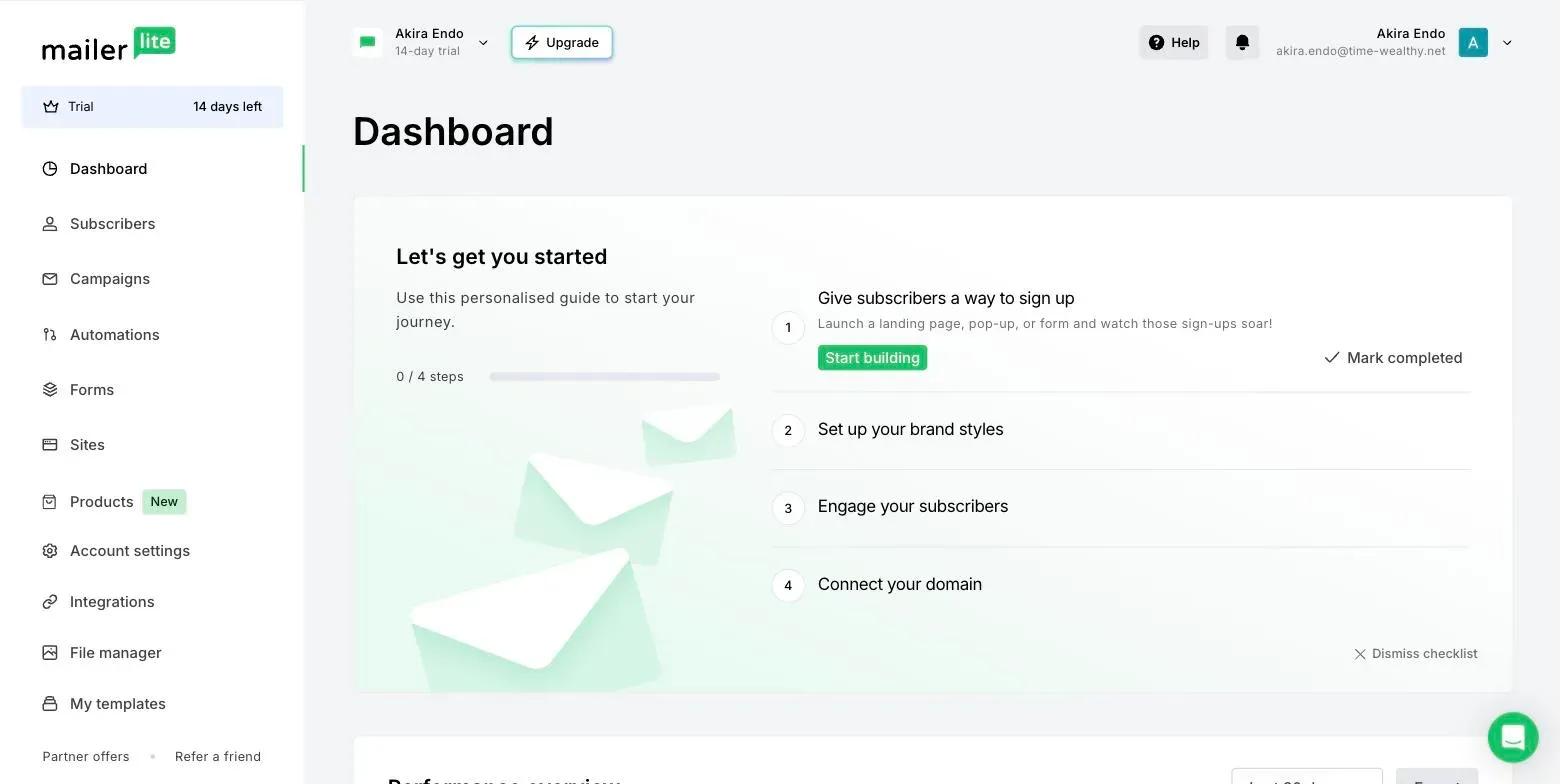
You start on a trial of the paid product, not the free plan. Signup lands you on a 14-day trial with the paid features switched on, labelled as such in the sidebar from the first screen. No card is taken, so the end of the trial costs you features rather than money — but if you came for the free plan, know that you’ll be evaluating the paid one and downgrading afterwards:
It wants your postal address before you can use anything. Onboarding blocks until you provide a physical mailing address, cited as regional compliance:
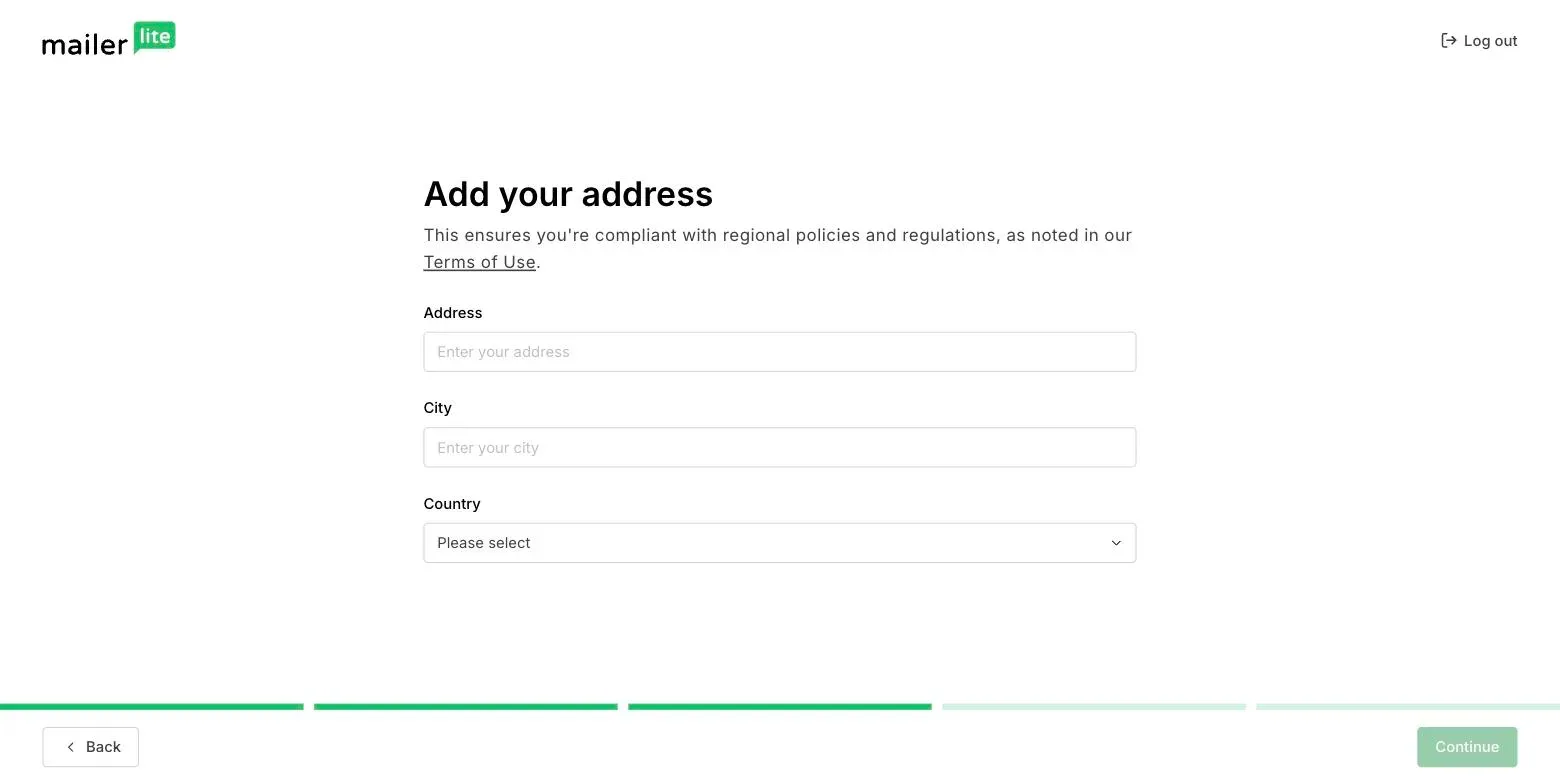
Anti-spam law requires a sender address in your emails eventually, so the request itself is standard practice. Asking at the door, before you’ve seen the product, is not — none of the other five tools we opened accounts on blocked onboarding for it. It cost us two minutes and a moment of “wait, why?”, and now it costs you neither.
Every tier gets the whole toolkit
The structural thing MailerLite gets right — and the reason it earns a place on shortlists beyond “it’s cheap” — is that features are not the upgrade lever. The automation builder, multi-step sequences with branching, landing pages, pop-ups, embedded forms and segmentation all come with Comfort at $19. Upgrades buy capacity and some operational extras, not the product’s core.
The comparison that makes this concrete: Kit’s free plan caps you at one basic automation, and unlocking real branching costs $39 — the exact machinery MailerLite includes at half that. We’ve mapped that dividing line in detail in Kit vs MailerLite, but the short version is that MailerLite is what you pick when automation is the point and budget is the constraint.
The same logic cuts against the tools that meter capability. Mailchimp’s cheap Essentials tier strips automations; GetResponse ladders features across four plans. MailerLite’s pitch is that you never discover, three months in, that the feature you now need lives one tier up. In this category, that’s rarer than it should be.
What it doesn’t do
An honest shortlist needs the other column.
No built-in monetisation. There’s no native paid-subscription mechanism or product checkout in the core toolkit — if readers are going to pay you, that’s your Stripe, your storefront, or a different tool. Newsletter-first platforms with payments built in are a different shape; we compared those in our Substack alternatives breakdown.
No discovery. beehiiv has cross-newsletter recommendations and Substack has its network; MailerLite has nothing that sends you readers. It’s infrastructure, not a platform — every subscriber is one you found yourself.
The curve, again. Worth repeating as a weakness rather than a footnote: at 25,000 subscribers MailerLite is one of the more expensive tools we measured. The features that were a bargain at $19 are not a bargain at $179, because by then several competitors include more — monetisation, discovery, gentler pricing — for less.
The Mailchimp question
The comparison most people actually need is with the incumbent, because “should I just use Mailchimp?” is where half of these shortlists start. (A framing note: we hold a MailerLite account; we have not signed up to Mailchimp, so its side of this section is published pricing rather than hands-on experience.)
On headline price, Mailchimp wins: Essentials posts $14.33 at 1,000 subscribers and $137.06 at 25,000 — under MailerLite at both ends. But three asterisks sit on those numbers. The displayed prices are a first-year promotional rate, discounted 15%, with the standard rate waiting in year two. Overage charges apply if you exceed the contact or send limits, which makes the headline a floor rather than a bill. And Essentials omits automations — the feature this entire comparison keeps turning on — which live on Standard at $24.30, $53.89 and $158.87 across our three list sizes.
Put automation back into the comparison and the picture flips at the entry point: Mailchimp Standard at $24.30 against MailerLite Comfort at $19, with MailerLite’s number being a real, non-promotional price with the full toolkit attached. At 25,000 the order flips again — Standard’s $158.87 undercuts Comfort’s $179, steep curve and all.
So the honest summary: choose on list size and reading tolerance. Under ~10,000 subscribers, MailerLite is cheaper for the product people actually mean and its invoice contains no surprises. Large and patient enough to parse promotional rates and overage rules, Mailchimp’s numbers genuinely come out lower. If a bill you can predict without footnotes is worth $2 a month to you, that’s MailerLite’s argument in one line.
A note on deliverability
Every MailerLite review eventually cites an inbox-placement percentage, and we’re not going to. Vendors advertise superior deliverability; none publish controlled comparisons; and third-party seed tests vary run to run by more than the gaps they claim to detect. Our position across this whole category is the same: treat deliverability marketing as noise, because the variables that dominate real-world placement — your domain’s reputation, your list hygiene, your authentication setup — travel with you, not with the tool. We haven’t load-tested MailerLite’s sending at scale, so we won’t launder someone else’s percentage into a finding.
Who should pick it
- You need real automation on the smallest budget. Branching sequences, buyer/non-buyer paths, tagging — at $19, nothing we measured matches it. This is MailerLite’s clearest win.
- You’re leaving an expensive tool and want one predictable bill. Full features on every tier means the invoice you calculate is the invoice you get, with no second upgrade hiding three months out.
- Your list will stay under ~10,000. The curve’s pain lives above that. Below it, Comfort pricing is consistently reasonable.
Who shouldn’t
- You want a free plan to operate on. 250 subscribers is a demo. Kit’s 10,000-subscriber free tier is the category’s answer to that brief.
- You’re building toward 20,000+. Price the destination: $179 at 25,000 against beehiiv’s $169 with monetisation and discovery included — MailerLite’s early advantage has fully inverted by then.
- The newsletter itself is the business. Paid subscriptions, recommendations, a reader network — that’s a newsletter platform’s job, not an email tool’s.
Frequently asked questions
Is MailerLite actually the cheapest? At entry, effectively yes among full-featured tools — $19 with the whole toolkit. Across a growing list, no: the 9.4× curve hands the advantage elsewhere past roughly 10,000 subscribers.
Does the free plan need a credit card? No card. It does require a postal address before you can use the product, and signup starts you on a 14-day paid trial you downgrade out of rather than on the free plan itself.
Will I get billed when the trial ends? No card was taken at signup, so a forgotten trial downgrades you; it doesn’t charge you.
MailerLite or Kit? One automation and a big list: Kit, free. Real branching on a budget: MailerLite. The full decision tree, with the exact crossover, is in Kit vs MailerLite.
Is annual billing worth it? Across the tools we measured, paying annually knocks roughly 10–18% off, and MailerLite sits in that band. The catch is the usual one: you’re prepaying a year on a list whose size — and therefore price tier — you’re predicting. On a fast-growing list, an annual plan bought at 1,000 subscribers doesn’t freeze the 1,000-subscriber rate as you grow; commit annually once your size has stabilised, not before.
How painful is migrating in — or out? The list itself moves as a CSV export in either direction; that part is an afternoon. What doesn’t move, from any tool to any tool, is the plumbing: automations, forms, landing pages and tagging logic get rebuilt by hand on the other side. That cuts both ways for MailerLite — cheap to arrive at, but every branching sequence you build here is a switching cost you’re accruing. Since its whole pitch is automation on a budget, expect to build many, and to feel it if you ever leave.
The verdict
MailerLite is the honest budget option in a category that mostly isn’t: the lowest meaningful entry price we measured, with the full toolkit attached and no feature ransom waiting on a higher tier. Its two real costs are a free plan too small to live on and a pricing curve that quietly repeals the bargain as your list grows.
Pick it deliberately, for the list you’ll have in two years rather than the one you have today — under 10,000 subscribers and automation-hungry, it’s very hard to argue with. Past that, do the 25,000-subscriber math before you build your plumbing here, because the switching cost later will be the automations you’re about to enjoy building.