ClickFunnels Alternatives for Bootstrapped Founders: What You Give Up at Each Price
ClickFunnels starts at $97 a month. That is the number that sends most people looking for an alternative, and it’s the wrong number to compare against — because the question isn’t what else costs less. Almost everything costs less. The question is what stops working when you pay less, and whether the thing that stops working is one you were going to use.
Most “ClickFunnels alternatives” lists answer that badly. They rank tools by price, imply the cheap one wins, and never say what the $97 was buying. So this comparison goes the other way: it starts from what ClickFunnels includes, prices five alternatives against it, and is specific about what each one drops.
All pricing was read off each vendor’s own pricing page on 21 August 2026, on monthly billing. Prices change; confirm before you commit.
Some links in this article are affiliate links — see our affiliate disclosure. It doesn’t change what we recommend.
What we have and haven’t tested. We run systeme.io’s free plan and the screenshots below are from our own account. We have not run ClickFunnels, Leadpages or Kajabi as customers — for those, everything here is published pricing and documented feature lists, checked against each vendor’s page rather than against other comparison articles. Where we describe a checkout we went through ourselves, we say so.
What the $97 is actually for
Strip the marketing and ClickFunnels’ entry plan gives you three things that cost real money elsewhere: unlimited funnels and pages on every tier, a mature template and training ecosystem, and checkout tooling built by people who sell for a living. It charges 0% on your sales.
What it does not give you at $97 is the thing most people assume: marketing automation arrives on Scale at $197, and the affiliate centre on Optimize at $297. There is no permanent free plan — a 14-day trial, credit card required.
So the honest framing of every alternative below is: which of those three do you actually need, and at what point does replacing them cost more than $97 in tools and integration work?
Five alternatives, priced against $97
Monthly billing, entry plan:
| Entry price | Free plan | Funnels | Email included | Transaction fee | |
|---|---|---|---|---|---|
| ClickFunnels | $97 (Launch) | No — 14-day trial, card required | Unlimited, all tiers | Yes, 50k sends/mo on Launch | 0% |
| systeme.io | $0 (permanent) | Yes — 2,000 contacts, 3 funnels | 3 → 10 → 50 → unlimited | Yes, unlimited sends every tier | 0% |
| GetResponse | $19 (Starter) | Yes — 500 contacts | Marketer plan ($59) and up only | Yes, its core strength | 0% on course sales (Creator+) |
| Leadpages | $10 (HTML Pub Starter) / $99 (Grow) | No — 7-day trial, card required | Landing pages only | No — none | Not published |
| Kajabi | $179 (Basic) | No — 14 days at our checkout | Unlimited, plus courses | Yes, 2,500 contacts | 0% with Kajabi Payments |
| Podia | $42 (Mover) | No — 30-day trial, no card | Landing pages + checkout | 100 subscribers included | 5% on Mover, 0% above |
Two of those rows deserve flagging before anything else.
GetResponse’s $19 does not include funnels. The funnel feature most people are shopping GetResponse for starts on the Marketer plan at $59 (at 1,000 contacts). We priced this by moving GetResponse’s own list-size slider rather than reading its default view, because the headline price and the plan you’d actually need are different plans.
Leadpages has no email marketing at all. It is a landing page and conversion tool that expects you to connect an external provider. Comparing its $10 tier to ClickFunnels’ $97 is comparing a component to a stack.
The number that actually matters: two years
A subscription decision is not a monthly decision. Here is the same table run over 24 months, assuming you stay on the entry plan that can actually do the job:
| Month 1 | 12 months | 24 months | |
|---|---|---|---|
| systeme.io (free) | $0 | $0 | $0 |
| systeme.io (Startup $17) | $17 | $204 | $408 |
| Podia (Mover $42) | $42 | $504 | $1,008 |
| GetResponse (Marketer $59) | $59 | $708 | $1,416 |
| ClickFunnels (Launch $97) | $97 | $1,164 | $2,328 |
| Leadpages (Grow $99) + email | ~$118 | ~$1,416 | ~$2,832 |
| Kajabi (Basic $179) | $179 | $2,148 | $4,296 |
Two years of ClickFunnels is $2,328. Two years of systeme.io’s free plan is nothing, and two years of its Startup plan is $408 — a difference of roughly $1,900 either way.
That gap is the real question this article is about, and framing it as “$97 versus $17” understates it by an order of magnitude in absolute terms. It also cuts the other way: if your funnel produces more than about $100 a month in profit that the cheaper tool would fail to produce, the expensive tool is the cheaper one. Everything below is an attempt to help you work out which side of that line you’re on.
One caveat on the table: GetResponse and Kajabi both price on contacts, so those columns grow as your list does. At 25,000 contacts GetResponse’s Starter plan alone reaches $174 a month — above ClickFunnels. systeme.io, Podia and ClickFunnels hold their price as you grow, which matters more than the starting figure if you’re actually building a list.
systeme.io: the only genuinely free answer
If the $97 is the problem, systeme.io is the direct solution, and it isn’t close. Its free plan is permanent — not a trial — and covers 2,000 contacts, 3 funnels, 1 course, 1 community, unlimited email sends and 0% transaction fees, with no credit card.
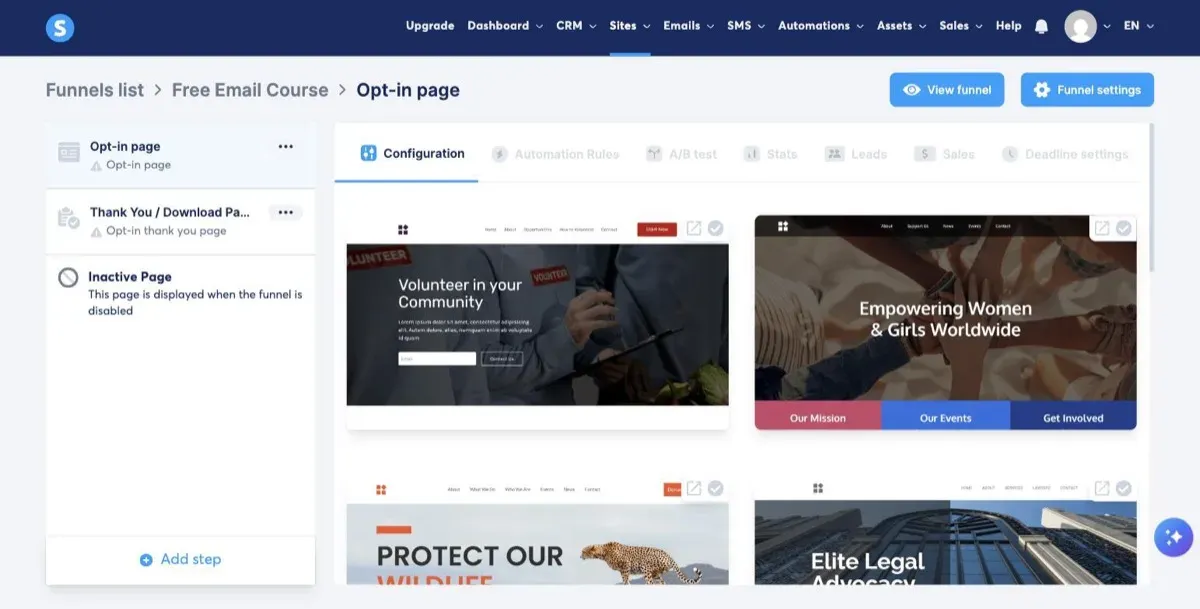
We opened an account to check, and the claim holds. Choosing “build an audience” as the funnel goal scaffolds a working two-step funnel automatically — opt-in page and thank-you page, pre-wired — then asks you to pick a template for each step:
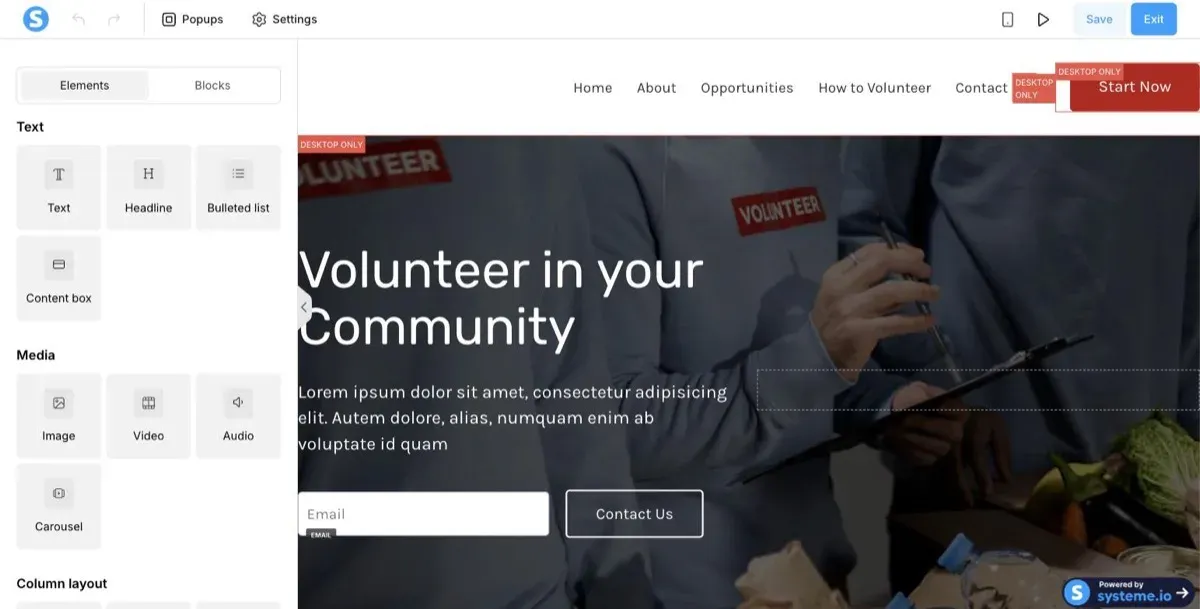
Each page opens in a block-based drag-and-drop editor. It is closer to a simple website builder than to ClickFunnels’ more elaborate canvas, which for a first funnel is a feature rather than a limitation:
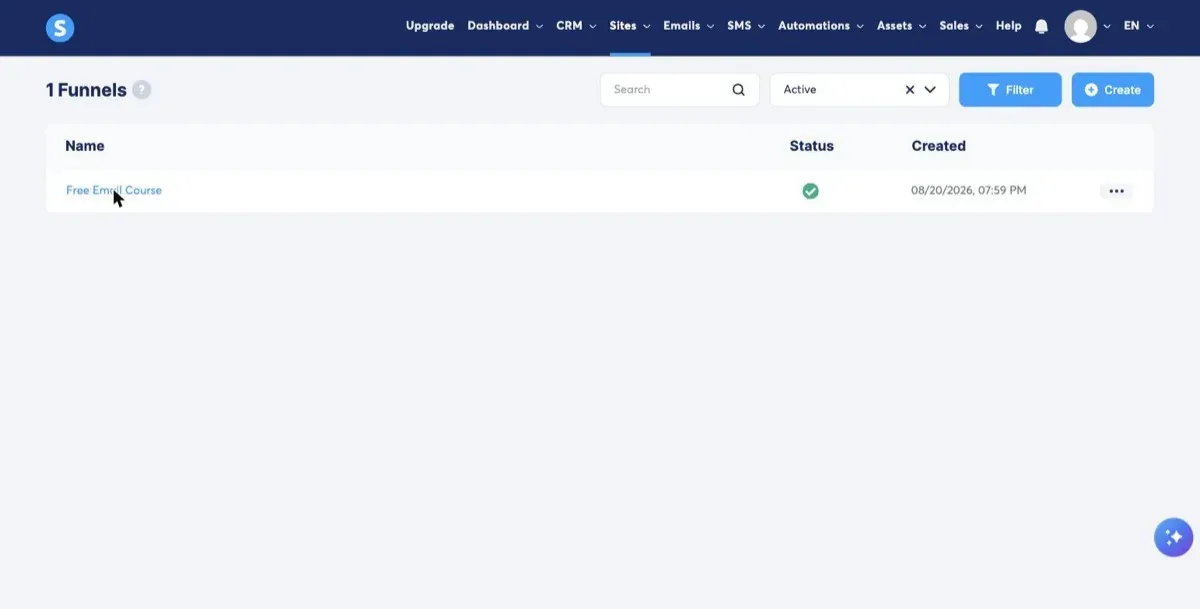
The finished funnel then lists in the dashboard like any other, with its steps and stats attached — from a blank account to an editable two-step funnel took us under ten minutes, most of it spent browsing templates:
Two honest observations from that account. Free-plan pages carry a “Powered by systeme.io” badge — expected at $0, but know it’s there before you send paid traffic. And the funnel sits on a systeme.io subdomain until you connect a custom domain, which the free plan includes.
The paid tiers stay aggressive: Startup $17 (5,000 contacts, 10 funnels), Webinar $47, Unlimited $97 — the same price where ClickFunnels starts. Automation is thin on the lower tiers, and the template ecosystem is smaller and less polished.
What you give up versus ClickFunnels: funnel-building depth, A/B testing culture, template variety, and the training ecosystem. What you keep: funnels, email, checkout, courses, and 0% fees, for nothing.
No card, and the free plan doesn’t expire — you can rebuild your current funnel before deciding whether to move anything.
GetResponse: when email is the real engine
GetResponse makes sense as a ClickFunnels alternative in one specific case: your funnel is mostly an email sequence with a landing page attached, rather than a multi-step checkout flow.
Its email side is genuinely strong and unlimited sends come on every paid tier. Its funnels are competent rather than deep. Priced honestly, that means $59/month at 1,000 contacts for the plan that actually has funnels — which is cheaper than ClickFunnels but not dramatically, and the gap narrows as your list grows: at 25,000 contacts, GetResponse’s Starter plan alone is $174.
What you give up: funnel depth and checkout optimisation. What you keep: better email than ClickFunnels, plus webinars on higher tiers.
Leadpages: only if you already have the rest
Leadpages is the cheapest row in the table and the least comparable. It builds landing pages well and does not do email, funnels or checkout in any sense ClickFunnels would recognise.
It’s the right answer if you already pay for an email tool and a checkout you’re happy with, and you just want better pages. It’s the wrong answer if you’re trying to replace a stack, because you’ll rebuild the rest around it and end up above $97 anyway.
Its trial is seven days and requires a card — the shortest evaluation window of anything here.
Kajabi: the more expensive alternative
Kajabi is on this list because people genuinely cross-shop it, not because it saves money. At $179 it is nearly twice ClickFunnels’ entry price.
It earns that only if you’re selling courses and would otherwise pay for a course platform and a funnel builder and an email tool. If you’re not selling courses, it’s the wrong direction entirely.
One thing worth knowing before you evaluate it: Kajabi advertises a 30-day trial in places, but the checkout we went through offered 14 days, card required, billed automatically afterwards. Diary the cancellation date from the screen you actually see. Our full breakdown is in the Kajabi alternatives comparison.
Podia: the easiest one to actually try
Podia is the only tool here whose trial takes no credit card at all — 30 days, full platform. For someone who has been burned by a trial that auto-billed, that is worth more than a few dollars of monthly difference.
At $42 it includes courses, digital downloads, coaching, community, a website builder and landing pages. The catch is email: 100 subscribers on Mover, and the price of adding more isn’t published on its pricing page, so the number that decides whether Podia is cheap for you is one you have to ask for. Mover also carries a 5% transaction fee.
When you should stay on ClickFunnels
This is the section most alternatives articles leave out, and it’s the one that decides whether the rest is trustworthy.
Stay if funnel craft is your competitive edge. ClickFunnels’ depth in split testing, checkout optimisation, order bumps and one-click upsells is real, and the tools above are not close on that specific axis. If a one-percent conversion improvement is worth more than $80 a month to you, the cheaper tool is the expensive choice.
Stay if you’re already running traffic profitably. The migration cost of moving live funnels — rebuilding pages, re-testing checkout, re-pointing domains — is paid in downtime and broken tracking, not in subscription dollars.
Stay if the ecosystem is doing work for you. The training, community and template library around ClickFunnels are a genuine asset for someone still learning funnel structure. systeme.io will hand you an empty canvas and a shorter manual.
Fourteen days, card required — set a cancellation reminder before you start.
What moving actually costs
The subscription saving is the easy half of the calculation. Here is the half that gets underestimated, in rough order of how much time it takes.
Pages don’t port. There is no export format shared between funnel builders. Every page is rebuilt by hand in the new editor. For a three-step funnel that’s an afternoon; for a catalogue of tested landing pages it’s a week you didn’t plan for.
Checkout is the risky part. Payment processor connections, order bumps, upsell flows and tax settings all get rebuilt, and mistakes here fail silently — a checkout that loads but doesn’t charge looks fine until you check the deposits. Test with a real card before you send traffic.
Automations don’t migrate; the list does. Subscribers export to CSV and import cleanly anywhere. Sequences, tags, triggers and the logic connecting them do not. If your funnel’s value is in a welcome sequence that segments buyers from browsers, budget for rebuilding that from scratch.
Tracking resets. Pixels, conversion events and analytics history stay behind. You lose the baseline you’d measure the move against, which is a real cost if you’re mid-optimisation.
Links break unless you’re careful. Anything you’ve shared — email footers, social bios, paid ads, other people’s blog posts — points at the old URLs. Map redirects before you switch, not after.
None of this argues against moving. It argues for moving early, while there’s little to move, which is exactly the position of someone still on ClickFunnels’ trial or first month. The cost of switching rises faster than the cost of staying.
Which alternative fits which founder
Pre-revenue, validating an offer → systeme.io, free plan. Nothing else here lets you build and test a real funnel at $0, and the paid ceiling is $97 — where ClickFunnels begins.
Your funnel is really an email sequence → GetResponse, on Marketer at $59. Price it at the list size you’re growing into, not today’s.
You already have email and checkout, you just want better pages → Leadpages. Component, not stack.
You’re selling courses and would replace three subscriptions → Kajabi, and only then.
You want to evaluate without handing over a card → Podia. Thirty days, no card, whole platform.
Frequently asked questions
Is there a free alternative to ClickFunnels? systeme.io’s free plan is the only permanent one here — 2,000 contacts, 3 funnels, 1 course, unlimited email sends, 0% transaction fees, no card. GetResponse’s free tier exists but has no funnels; everything else is a trial.
Will I lose sales by moving off ClickFunnels? Possibly, and that’s the honest answer. The features you’d be leaving — split testing, checkout optimisation, upsell flows — are the ones that lift conversion. If your funnel is already profitable, model the conversion risk before the subscription saving.
What’s the cheapest way to run a complete funnel? systeme.io free, at $0, if 2,000 contacts and 3 funnels fit your stage. It is the only option here that covers pages, email and checkout in one place without a bill.
Does ClickFunnels charge a percentage of sales? No — 0% on all plans. The subscription is the whole cost, which is part of why the entry price is what it is.
Bottom line
The reason to leave ClickFunnels isn’t that $97 is expensive in the abstract. It’s that $97 buys funnel depth, and funnel depth is worth nothing to someone who hasn’t validated the offer yet.
If that’s you, start on systeme.io’s free plan and let revenue justify the upgrade. If you’re past that point and running traffic that converts, the cheaper tool is the expensive one — and the honest recommendation is to stay where you are.