Kajabi vs Thinkific: Which Course Platform Fits Your Business?
Kajabi and Thinkific end up on the same shortlist constantly, but they’re built around different bets. Kajabi bets you want your course platform to be your marketing stack — email, funnels, CRM, automations, all in one bill. Thinkific bets you want an excellent course platform at a fair price and you’ll bring (or already have) your own marketing tools.
That framing decides most head-to-heads before any feature table does. Kajabi’s cheapest widely-offered plan costs more than three times Thinkific’s — which is either overpriced or a bargain, depending entirely on how many other subscriptions it deletes for you.
All pricing below was read off both vendors’ official pricing pages on 21 August 2026, and the standalone email costs in the scenarios come from GetResponse’s own pricing slider at each list size. Prices change; confirm before you commit.
What we have and haven’t tested. The pricing and plan limits here are desk work, checked line by line against both vendors’ pages. Everything we say about using the two platforms comes from accounts we opened ourselves and then cancelled. We ran the same exercise on each — read the checkout, build a course skeleton, look at what the trial actually signs you up for — and both hands-on sections below are what we saw on our own screens. Where a claim comes from a vendor’s page instead, we say so in the sentence.
Some links in this article are affiliate links — see our affiliate disclosure. It doesn’t change what we recommend.
The short version
- Pick Thinkific if you mainly need a course platform: unlimited courses and a 10,000-student allowance from its cheapest plan, predictable 2.9% payment processing, roughly a third of Kajabi’s price.
- Pick Kajabi if it will replace an email tool, a funnel builder, and a landing page tool at the same time: unlimited email sends, funnels, and landing pages on every plan — priced accordingly.
- The price gap never really closes — even at the tiers that remove each platform’s branding, Kajabi costs more than twice as much. What changes with scale is the total math: once your email list is large, Kajabi’s bundled contacts can beat Thinkific plus a separate email tool (scenarios below).
Pricing head to head
| Kajabi | Thinkific | |
|---|---|---|
| Entry plan | Basic $179/mo ($143 annual-equiv.) | Basic $54/mo ($40 annual-equiv.) |
| Mid plan | Growth $249/mo ($199) | Start $109/mo ($82) |
| Upper plan | Pro $499/mo ($399) | Grow $219/mo ($164) |
| Free trial | 14 days at our checkout (30 advertised in places) — card required | 30 days, as advertised — card required, and it trials the $109 Start plan |
| Free plan | No | No |
Two notes on reading this table honestly. Kajabi also lists a Starter tier below Basic — 1 product, 250 contacts — but its price isn’t shown in the pricing table itself, and at those limits it’s closer to a demo than a business plan, so we compare from Basic. And Kajabi runs aggressive promotional discounts fairly often; budget on standard rates, since renewals happen at standard rates.
What you get for the gap
The $125/month difference between the two Basic plans buys exactly one thing: Kajabi’s marketing stack.
On every Kajabi plan: unlimited email sends, unlimited landing pages, unlimited funnels, marketing automations, and a built-in CRM with contact allowances included in the subscription (2,500 on Basic, 25,000 on Growth). If you’re currently paying for an email platform and a funnel or landing page builder, Kajabi plausibly replaces both — and mid-tier email tools alone run $50–100/month at a few thousand subscribers.
Thinkific’s approach: the platform focuses on courses and commerce, and connects to your existing email tool instead of replacing it. Its own strengths are structural: unlimited published courses on every plan, 10,000 students even on Basic, and a well-regarded drag-and-drop course builder with AI-assisted course outlines.
So the first decision question is concrete: list the marketing subscriptions you’d actually cancel if you moved to Kajabi. If the answer is “none, I like my tools” — the price gap is pure overhead, and Thinkific wins on arithmetic. If the answer is two or three products, price the bundle before assuming Kajabi is expensive.
Payments and fees: both fine, differently shaped
Neither platform charges a platform transaction fee when you use its native payments — but the details differ in ways that matter at volume.
Thinkific: a flat 2.9% through Thinkific Payments, on every plan, with no separate platform fee. Simple to model. If you insist on connecting Stripe or PayPal directly instead, a third-party gateway fee applies that varies by plan — Thinkific doesn’t publish a clean rate table for it, so ask their support before choosing that route.
Kajabi: with Kajabi Payments, card processing starts at 2.9% + 30¢ and improves slightly on higher tiers — 2.8% + 30¢ on Growth, 2.7% + 30¢ on Pro. The trap is third-party processing: route payments outside Kajabi Payments and a platform fee applies on top, and it’s steeply tiered — 5% on Starter, 2% on Basic, 1% on Growth, 0.5% on Pro. On Basic that 2% is $20 out of every $1,000 you sell, in exchange for nothing. Practical translation: if you choose Kajabi, use Kajabi Payments.
Limits: where each platform pinches
The two platforms meter completely different resources, which is why sticker-price comparisons mislead.
Kajabi meters products and contacts. Basic: 5 products, 2,500 contacts. Growth: 50 products, 25,000 contacts. Pro: unlimited products, 100,000 contacts — and Pro is the only tier that removes Kajabi branding. Your email list size effectively sets your Kajabi tier — a fast-growing list can force an upgrade even if your course catalog never changes.
Thinkific meters bandwidth and features. Students (10,000) and published courses (unlimited) are generous everywhere, but video bandwidth is capped: 100 GB/month on Basic, 200 GB on Start, 400 GB on Grow. More importantly, the commerce features most creators eventually want — memberships, bundles, private courses, completion certificates, Zoom integration — sit on Start ($109/mo), not Basic. Budget for Start if you’re selling seriously; Basic is best understood as a full-featured on-ramp.
Branding removal is where the two diverge most sharply, and it’s the detail most comparisons get wrong. Thinkific drops its branding on Grow ($219/mo). Kajabi holds it back until Pro ($499/mo) — Growth does not remove it. If an unbranded checkout matters to you, that’s a $280/month gap, not a rounding error.
Mobile apps run the other way. Kajabi includes a branded mobile app from Growth ($249/mo) upward, which its pricing page labels a “$199/mo value”. Thinkific prices a branded app at $199/mo but presents it as included with select enterprise plans rather than as an add-on you can attach to Basic, Start, or Grow — so if a branded app is essential, ask Thinkific whether you can buy one at your tier at all. On this single feature, Kajabi Growth is the cheaper route.
The real math: three total-cost scenarios
Because Kajabi bundles email and Thinkific doesn’t, the honest comparison is Kajabi against Thinkific plus an email tool. We use GetResponse’s Starter plan as the representative standalone email cost — its list-size pricing is public, so you can check our arithmetic: $19/mo at 1,000 contacts, $54/mo at 5,000, and $174/mo at 25,000, all on monthly billing. Here’s how the totals compare at three business sizes:
Scenario 1 — first launch, ~1,000 subscribers. Thinkific Basic ($54) + email at 1,000 contacts ($19) = $73/mo, against Kajabi Basic at $179/mo. At this stage the bundle argument hasn’t kicked in: you’re paying $106/month extra for automation depth you likely aren’t using yet. Thinkific wins comfortably.
Scenario 2 — growing list, ~5,000 subscribers, selling steadily. Thinkific Start ($109, because you now want memberships and bundles) + email at 5,000 contacts ($54) = $163/mo, against Kajabi Basic at $179/mo — near parity, and Kajabi’s version includes funnels and unlimited landing pages the Thinkific stack doesn’t. This is the crossover zone where the decision genuinely flips on how marketing-driven your sales are.
Scenario 3 — email-driven business, ~25,000 subscribers. Thinkific Grow ($219) + email at 25,000 contacts ($174) = $393/mo, against Kajabi Growth (25,000 contacts included) at $249/mo. The bundle now saves real money and removes an integration. If your list is the engine of your revenue, Kajabi’s pricing model starts working for you instead of against you.
The pattern: Thinkific wins early, the gap closes with list growth, and Kajabi can win outright once your contact count is the biggest line item. Run this math with your own numbers and your own email tool’s rates before deciding — the crossover point moves with the email provider you’d otherwise pay for.
Beyond courses: communities, coaching, and downloads
Both platforms have grown past video lessons, in different directions.
Thinkific includes digital downloads (5 on Basic, unlimited from Start), coaching and webinar sessions as sellable products (5 on Basic, unlimited from Start), and communities — 1 on Basic and Start, 3 on Grow, with community “spaces” scaling by tier. Completion certificates arrive on Start. It’s a genuinely broad commerce surface at the mid tier.
Kajabi includes communities on every plan (1 on Basic and Growth, 3 on Pro) and leans its product breadth toward marketing objects instead: unlimited landing pages, funnels, and email sequences are the “extra products” in practice. Higher tiers add an affiliate program manager (Growth and up) — relevant if you plan to recruit partners to sell your course, and something Thinkific handles differently across its plans, so check current terms if affiliates matter to you.
If your roadmap says “course now, coaching and downloads next quarter,” Thinkific’s Start plan covers that spread at $109. If it says “course now, launch funnel and affiliate army next quarter,” that’s Kajabi Growth territory.
Ease of getting started
Both platforms advertise a 30-day free trial. Only one of them gave us thirty days. Kajabi’s checkout offered fourteen, card required, with the plan price billed automatically afterward. Thinkific’s really was thirty — but it signed us up to a plan we hadn’t chosen. Read your own checkout screen carefully and diary the cancellation date before you start, whichever you pick.
Thinkific is the gentler of the two to learn, in part because the product surface is smaller: courses, checkout, community. Kajabi asks you to learn its funnel and email machinery to get your money’s worth, which is a feature if you’ll use it and friction if you won’t.
Hands-on: what Kajabi’s trial is actually like
We signed up for Kajabi’s trial while writing this comparison. Three observations from the first hour.
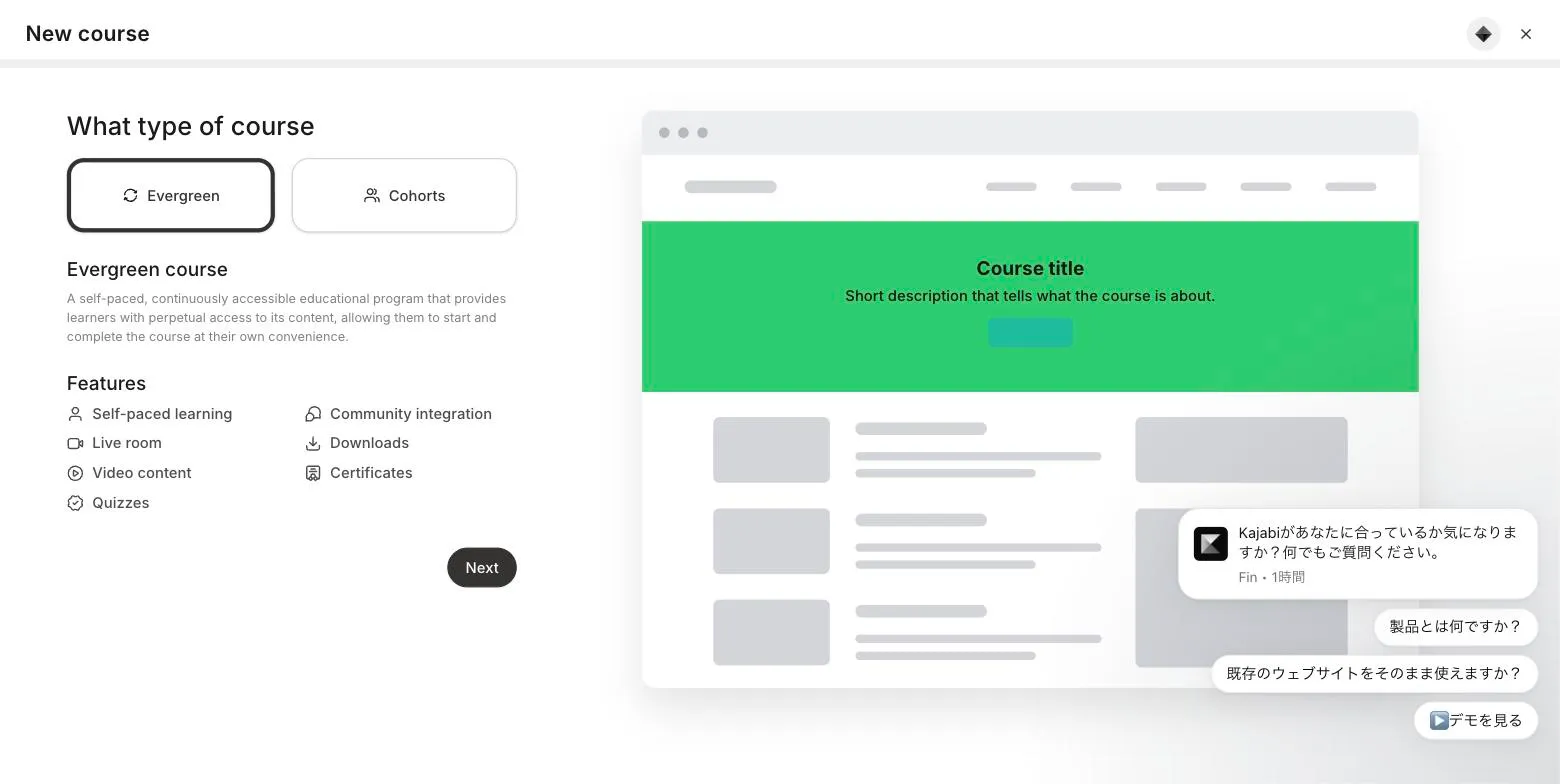
Course setup is a guided wizard. You choose between an evergreen (self-paced) and cohort-based course before anything else, then add a title and short description:
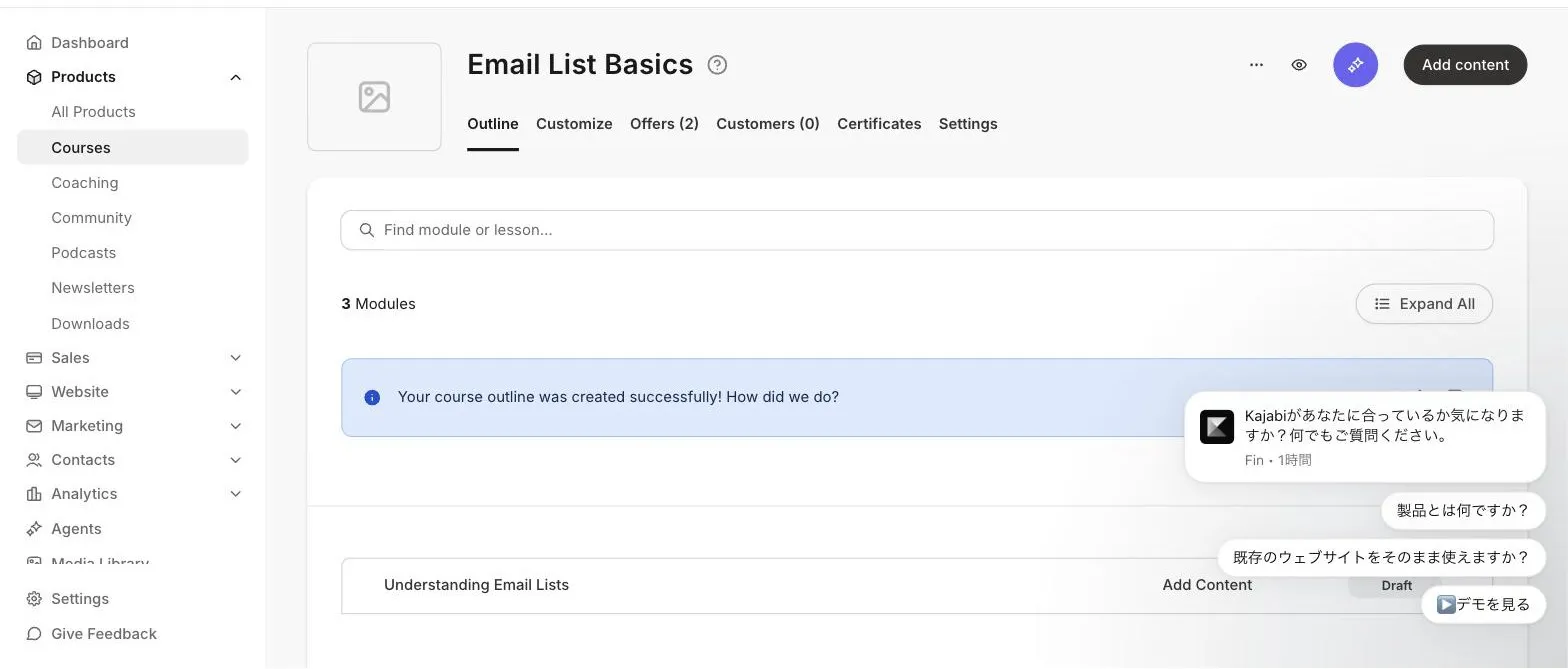
The AI outline is genuinely useful. From nothing but a title and a one-line description, Kajabi generated a three-module course outline with draft lessons — a real skeleton to edit rather than a blank page:
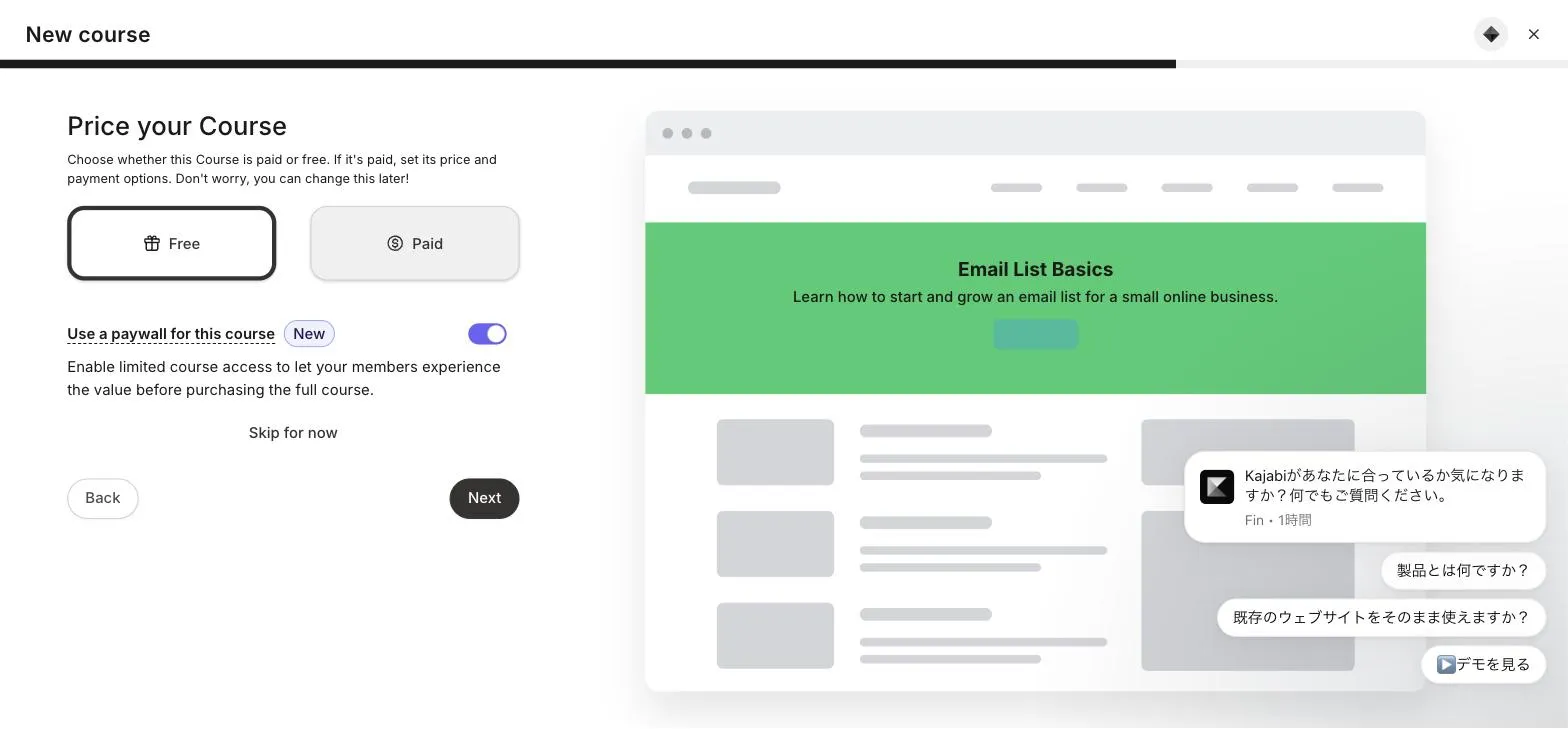
Pricing is part of course creation, not an afterthought. The wizard asks free-or-paid up front and offers a paywall option that gives prospects limited access before buying — the marketing DNA showing through:
The flip side of that marketing DNA: the trial checkout itself is an exercise in reading carefully (14 days at our signup despite 30-day messaging elsewhere, card up front, auto-billing after). It’s consistent with what Kajabi is — a sales machine — for better and worse.
Hands-on: what Thinkific’s trial is actually like
We opened a Thinkific trial and ran the same exercise. Four things stood out.
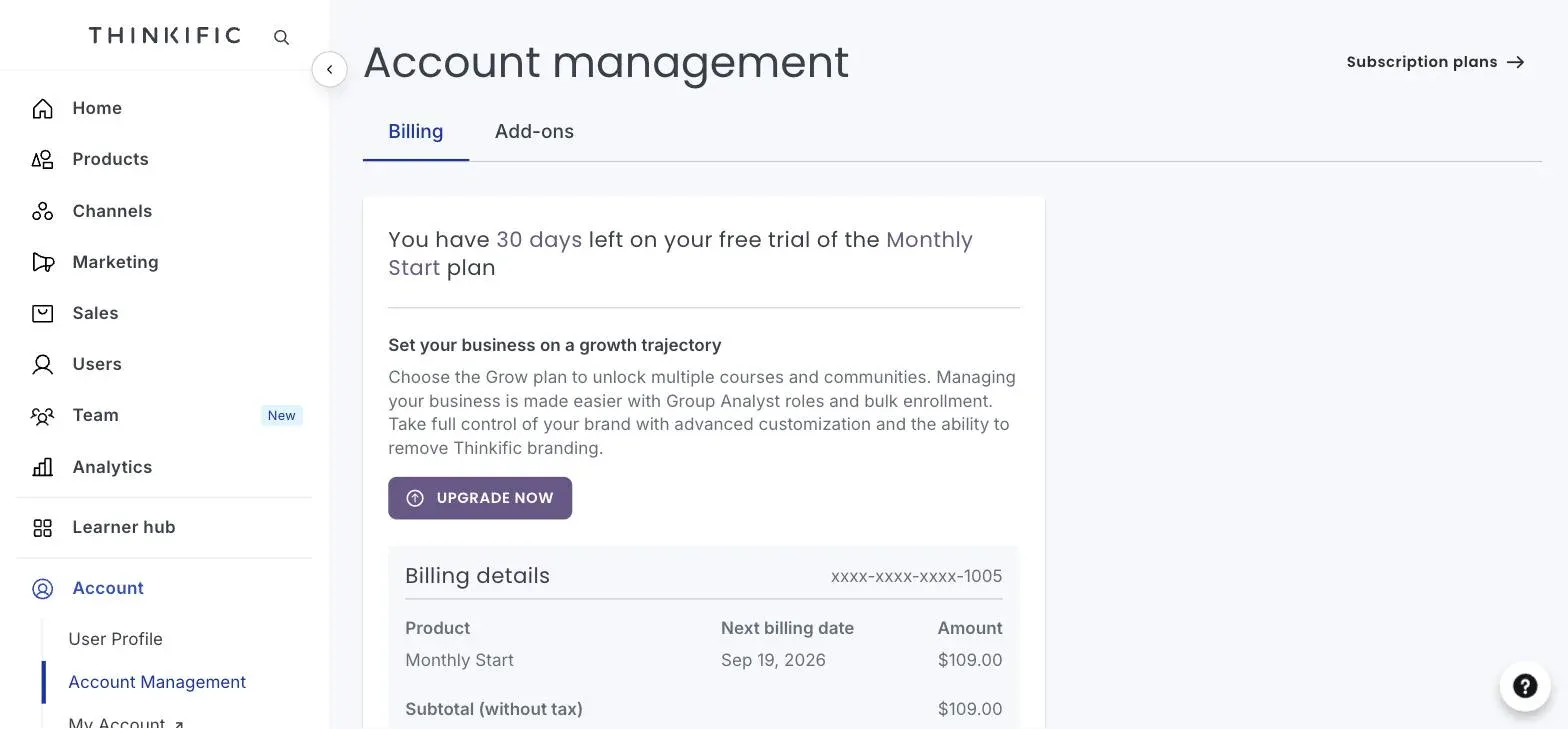
The trial signs you up to a plan you didn’t pick. Thinkific’s thirty days are real, with no fine print quietly shortening them. But the trial is attached to the Start plan at $109/month — not the $54 Basic plan that anchors its pricing page. Our billing screen showed the next charge dated thirty days out at $109 before we cancelled. If you start a trial assuming you’re testing the cheap plan, you aren’t, and the number that lands on your card is roughly double the one that brought you there.
Setup asks six questions before it shows you the product. Thinkific wants to know your profession, the size of your audience, what you’ve earned selling knowledge before, what you want to build first, whether it’s paid or free, and finally what the course is about. Kajabi drops you into a course wizard almost immediately. Whether six screens of personalisation feels like care or like a delay probably depends on how many SaaS onboardings you’ve sat through this year.
Its AI outline goes a step further than Kajabi’s. We gave it one sentence — a beginner course on shooting portraits with a smartphone:
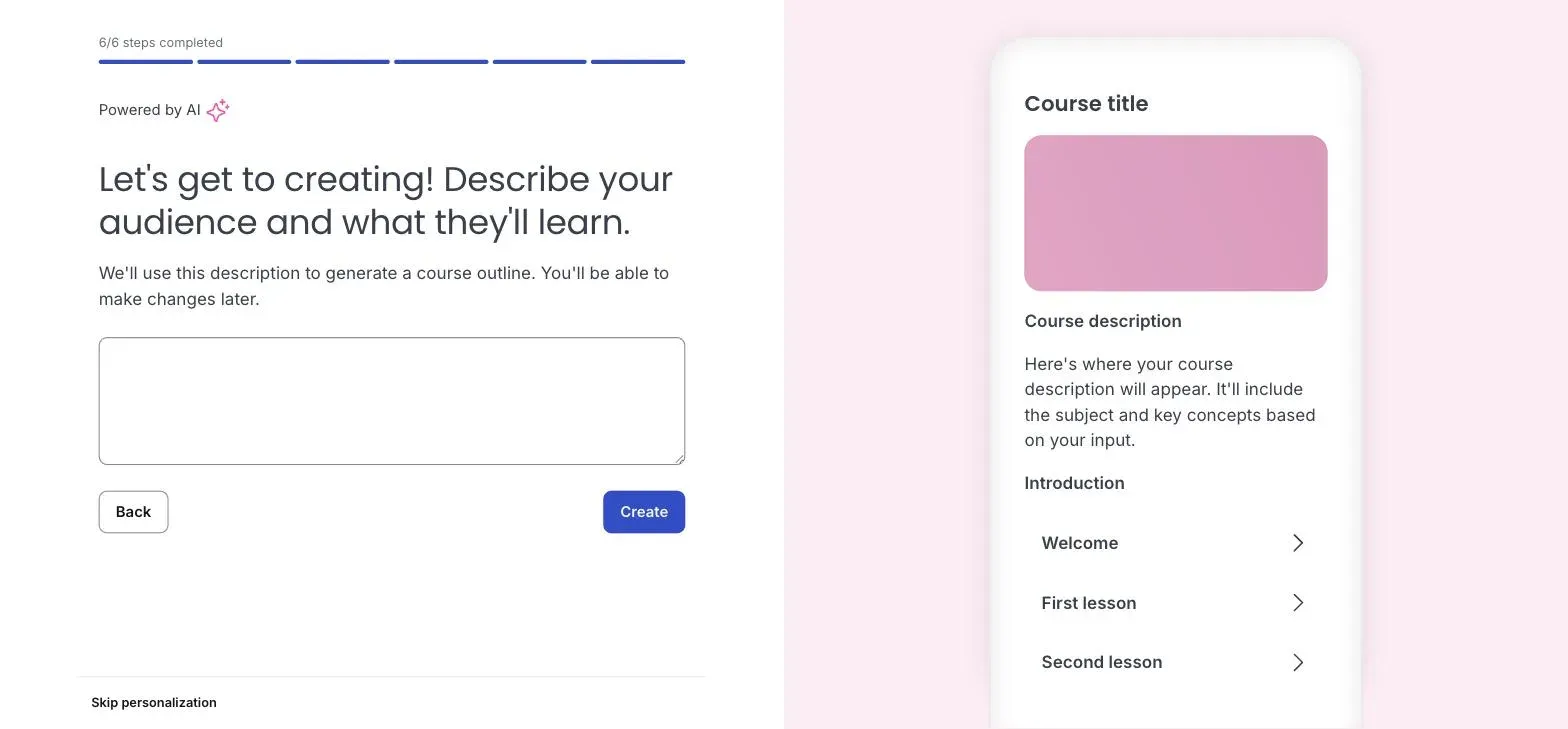
What came back was not just module headings. Thinkific produced chapters, lessons inside each chapter, and a content type for every lesson — video here, text there — then opened the first one in its editor with the video upload field ready:
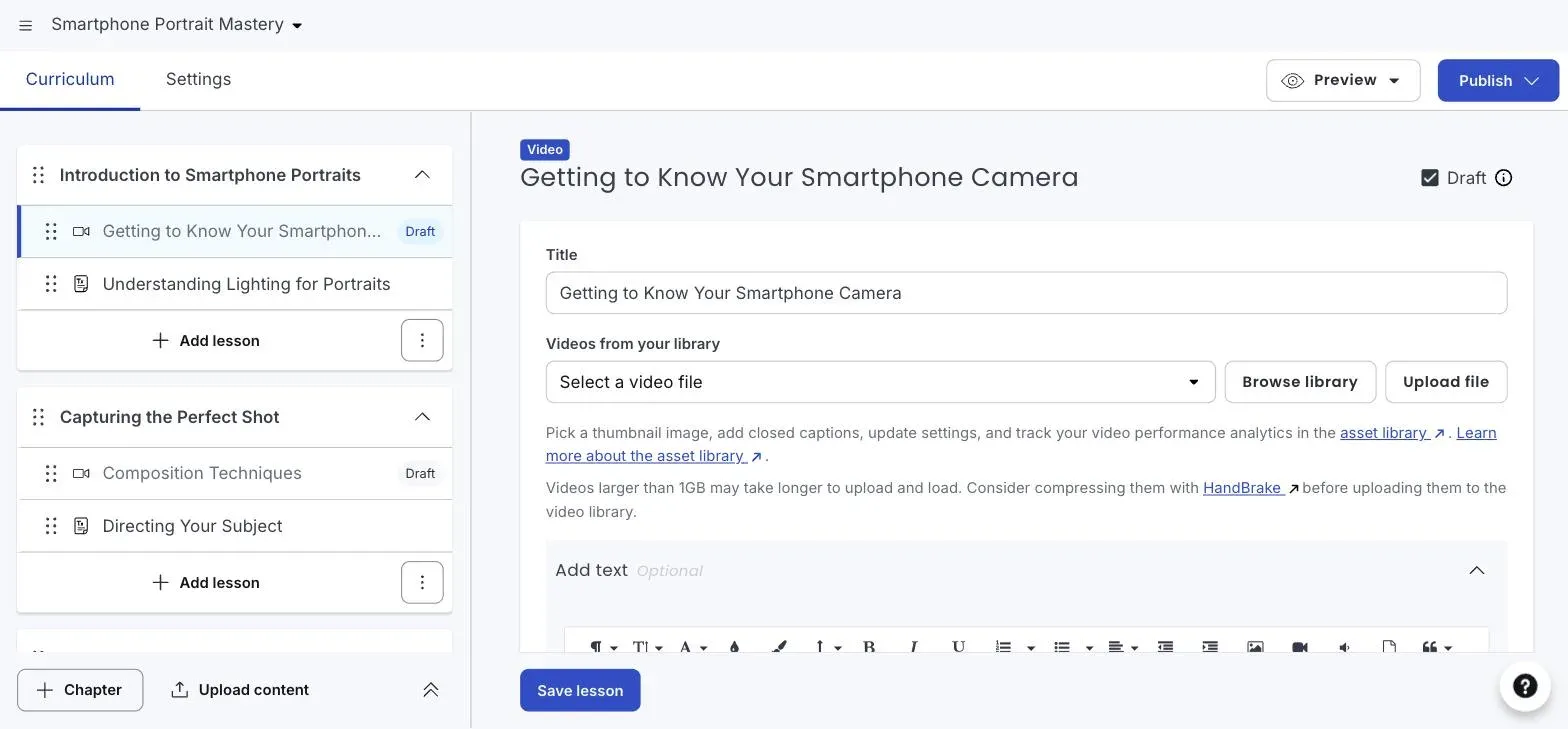
That’s a more finished skeleton than Kajabi’s three modules of draft lessons. Neither writes your course, but Thinkific hands you fewer decisions to make before you can start filling it in.
Cancelling offers you another thirty days. Starting a cancellation hands you off to a separate retention flow, and the first thing it does is offer thirty more free days:
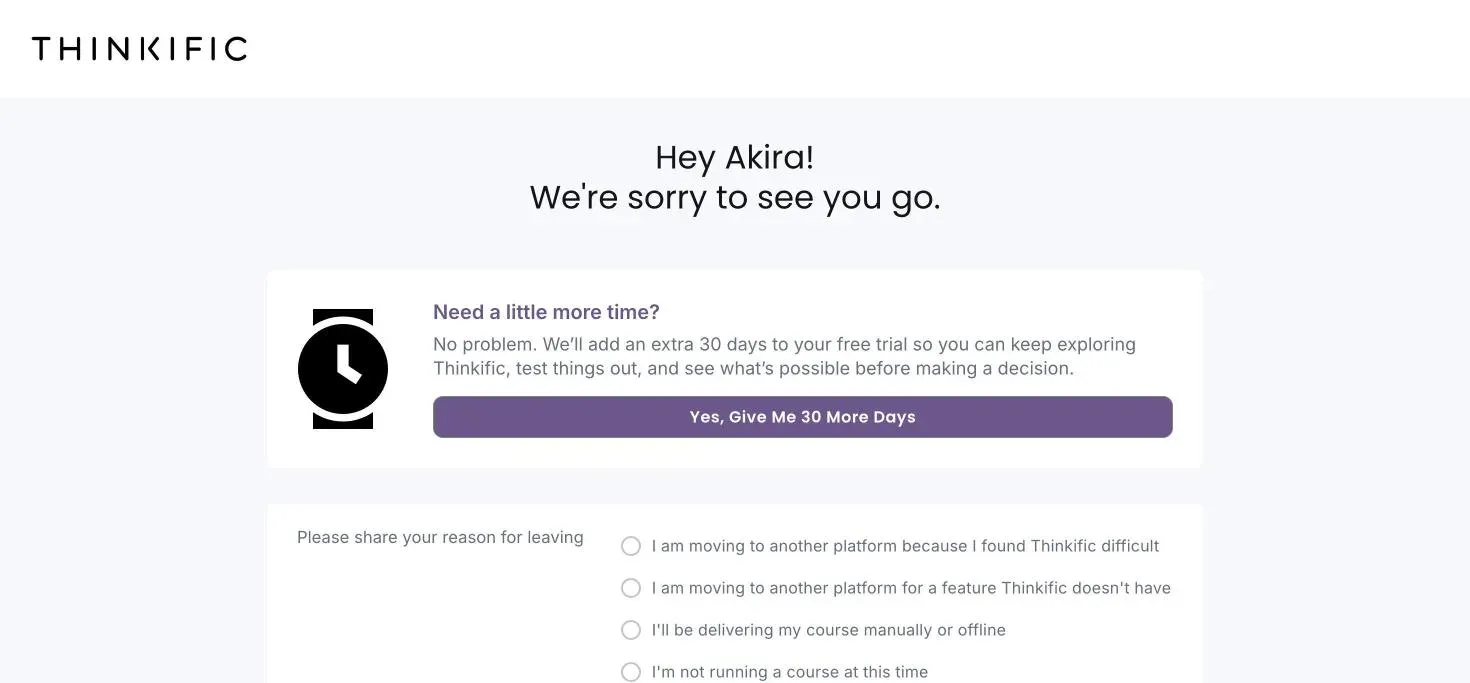
Decline it and the cancellation completes as a downgrade rather than a closure — content is kept, premium features fall away, and access continues to the end of the period. For us that made the effective free run sixty days for anyone willing to click through a cancellation screen. Worth knowing before you decide thirty days isn’t enough time to judge.
Who should pick which
Pick Thinkific if:
- Courses are the product, and your marketing stack already works
- You want the lowest predictable total cost at small-to-mid scale
- You value generous structural limits (courses, students) over bundled marketing
- You’re bandwidth-light: talking-head video, text, downloads
Pick Kajabi if:
- You’d cancel an email tool and a funnel/landing-page tool by switching — price the bundle, it’s often a wash or better
- Your business runs on email sequences and launch funnels, and you want them native to your course platform rather than integrated
- Contact-based pricing fits you: your list is meaningful but under the tier caps
- One login, one bill, one support team is worth a premium to you
Still torn? Take both trials (mind Kajabi’s shorter clock). Build the same one-module course in each, connect a test checkout, and send yourself the welcome sequence — Kajabi’s in-platform, Thinkific’s through your email tool. The friction you feel in that exercise is the real comparison.
Frequently asked questions
Is Kajabi worth the higher price? Only as a bundle. As a pure course platform it’s hard to justify against Thinkific’s pricing; as a replacement for course platform + email + funnels, the math frequently favors it. Count your cancellable subscriptions first.
Which is better for a first course? Thinkific’s Basic plan is the lower-risk start: less to learn, a third of the price, and unlimited courses to experiment with. Moving to Kajabi later is possible — course content migrates more easily than email automations do.
Do they take a cut of my sales? Not as a platform fee when you use their native payments — you pay standard card processing on both. Kajabi adds a platform fee only if you process payments through third parties; Thinkific adds a gateway fee for direct Stripe/PayPal connections that varies by plan.
Comparing more than these two? Our five-platform comparison adds Teachable, Podia, and LearnWorlds to the picture.
Bottom line
Thinkific is the better course platform per dollar; Kajabi is the better business-in-a-box if — and only if — you’ll actually use the box. Decide by counting the subscriptions Kajabi would replace, then take both trials and build the same small course in each. Two things to do before you start either one: set a cancellation reminder for Kajabi’s fourteen-day clock, and check which Thinkific plan your trial is actually attached to, because ours was the $109 one. Start free, decide with your hands.